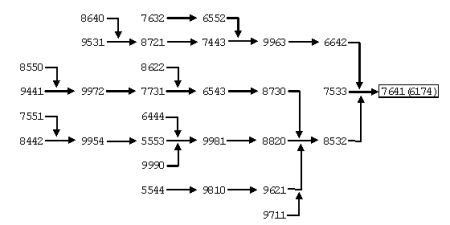
an intriguing task
a ppt is
here
with lots of subtracting to be done
and the tasks provide a sensible reason for introducing algebra (unlike life in general...)
start with any four, smallish, numbers - in any order, initially
calculate the positive difference between an adjacent pair of numbers, looping back to the start for the right-hand end number, to produce a new set of 4 numbers
keep on doing this, line by line
until you have a good reason to stop
Herbert Wills analysed this task in 1971 and gave it the name 'Diffy'
the work was brought to my attention by a fine booklet from 'Motivated Math Project' by Stanley Bezuska at Boston College Mathematics Institute (published in 1976, I think)
you can return to the basic task of doing a 'Diffy', year on year, with fresh and increasingly complicated starting four numbers - chosen as consecutive terms from various 'standard' number patterns (see below)
various algebraic skills can be practised for ever more complicated number patterns to establish a generalisation for the number of steps it always seems to take to reach 0 0 0 0
all starting arrangements of four numbers reduce to 0 0 0 0, quite quickly in most cases - usually in fewer than 7 steps
it's easy to make errors and tedious to check, so it can be helpful to set up a spreadsheet in advance
(using abs(difference between cells))
to begin the task(s):
ask students for any 4 numbers (not too big and not in any order) and then go through the 'diffy' process, without explanation - they try to sort out what the rules for constructing next lines are...
it is quite hard to find a set of numbers that involves more than six steps (iterations)
but it is possible
here are two examples
after a while playing around with any four numbers trying to better the "class (world) record" diffy
start to input four consecutive terms of a sequence and explore what happens
e.g. for a constant difference pattern:
following a sequence of lesson steps:
- try out several particular examples
- see what patterns are common to all the examples (or a few at least)
- decide how many steps a 'diffy' seems to take for a particular number pattern
- prove this using algebra
at various stages (maybe years) , the work can involve:
- consecutive multiples (start with a number keep multiplying by e.g. 2)
- a linear rule: start with a number, multiply by e.g. 3 and e.g. subtract 2 each time
- consecutive fibonacci numbers
- consecutive square numbers
- consecutive triangular numbers
- consecutive cubes
- consecutive terms of a general geometric sequence
these are all included on a
powerpoint
Puntmat have an interesting
variation
of this task, using the NLVM interactive square, asking students to
find a sequence of particular numbers after four iterations (steps)