these are based on an idea by Naoki Inaba
he produced the 'area mazes' as well as many other puzzles
he appears to refer to these shape tasks as Zukei puzzles (42 of them)
there are translations into the English/American names for shapes, done by Sarah Carter (who introduced them to a wider audience via her Math = Love blog)
she posted her translation from Japanese on Sat Dec 17th, 2016
one version of these is here
for those with tablet/laptop availability, Desmos have an activity builder (tool) that can be used when looking for the shapes in the original (Naoki Inaba) tasks, here
students can either construct lines or draw freehand and these steps can be reversed, or erased
many thanks to all of the above people
for my versions, there almost certainly needs to be a presentation/reminder about how you know lengths are the same - using the same or rotated vectors (or by involving pythagoras)
and how you can tell that lines are parallel or perpendicular
this is highly likely to involve vectors (maybe calling it a journey between two points)
join four dots to make a shape, as specified for a particular row
other dots are there to create the puzzle
some of the shapes are tilted
I've tried to create puzzles that have just one solution but I may well have overlooked some options...
(please let me know via the email address, bottom right)
for my shapes, in this task I have chosen not to involve special examples of e.g. a parallelogram should be a general example rather than a rhombus, rectangle or square
a ppt is here
median
don steward
mathematics teaching 10 ~ 16
don steward
mathematics teaching 10 ~ 16
Showing posts with label quadrilaterals. Show all posts
Monday, 16 December 2019
Thursday, 17 August 2017
quadrilaterals on a 3 by 3 dotty grid
now an oldish task
part of the South Nottinghamshire Project ('Journey into Maths')
by Alan Bell, David Rooke and Alan Wigley
published by Blackie in 1978
the teacher's guide claims there are a total of 94 different positions
counting translations, reflections or rotations
an intention might be that students do not count transformations of each shape (initially anyway)
i.e. find all the different ones that they can
in which case there are 16
part of the South Nottinghamshire Project ('Journey into Maths')
by Alan Bell, David Rooke and Alan Wigley
published by Blackie in 1978
the teacher's guide claims there are a total of 94 different positions
counting translations, reflections or rotations
an intention might be that students do not count transformations of each shape (initially anyway)
i.e. find all the different ones that they can
in which case there are 16
Thursday, 20 July 2017
grid kites and rhombuses
Pierre van Hiele advocates constructing the special quadrilaterals by means of reflections and rotations
that way the properties are easily deduced (e.g. "because of the mirror line") from the constructions
this has been explored more fully by Michael Villiers in South Africa, using an interactive geometry package
a powerpoint goes through the constructions (but it's probably better demonstrated with an interactive package)
that way the properties are easily deduced (e.g. "because of the mirror line") from the constructions
this has been explored more fully by Michael Villiers in South Africa, using an interactive geometry package
a powerpoint goes through the constructions (but it's probably better demonstrated with an interactive package)
Sunday, 8 January 2017
Friday, 6 January 2017
quadrilaterals on a grid
MathPickle (Gordon Hamilton in Calgary, Canada) have a task 'quadrilaterals on a grid' where students are asked to find special quadrilaterals on a 5 by 5 dotty grid with
(a) the biggest area and (b) the smallest area
with a restriction that the top left dot of the grid must be one of the quadrilateral's vertices
the task links to 'complete the quadrilateral'
MathPickle go on to consider a 9 by 9 dotty grid, with two fixed vertices, at (5, 2) and (1, 5)
this is presented on the MathPickle youtube (from 3.00 on) clip
(a) the biggest area and (b) the smallest area
with a restriction that the top left dot of the grid must be one of the quadrilateral's vertices
the task links to 'complete the quadrilateral'
MathPickle go on to consider a 9 by 9 dotty grid, with two fixed vertices, at (5, 2) and (1, 5)
this is presented on the MathPickle youtube (from 3.00 on) clip
Thursday, 31 January 2013
complete the quadrilateral
so, for this task:
- a parallelogram is not a rectangle or a square
- a kite is not a rhombus or an arrowhead
- a rhombus is not a square
- a trapezium is not an isosceles trapezium
- etc.
establishing that you have found the largest possible shape (in terms of area) is not that easy...
question 10 has an 'easy' answer that it is incorrect (with sides of length (root 5) and 2)!
many thanks to Fawn Nguyen for producing her own (neat and US-friendly) version of this task
see the related task from Math Pickle
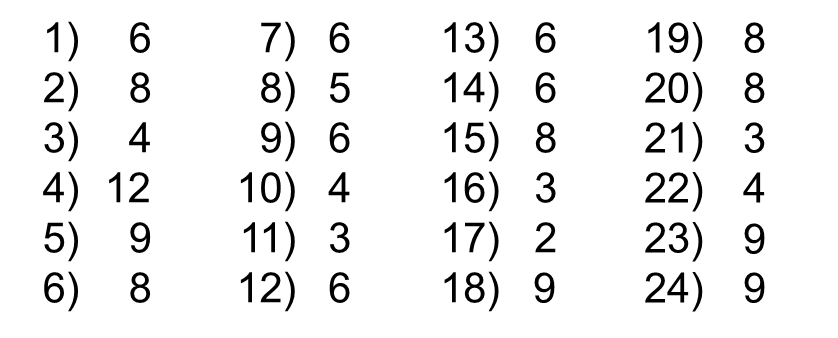
my solutions have these areas
(questions 21, 22 and 24 have two congruent shapes that will work)
Wednesday, 11 April 2012
creating quadrilaterals
Pierre van Hiele and Michael de Villiers have argued a case for creating (and so defining) special quadrilaterals from transformations
so that side and angle properties are easily deduced as a result of the transformation
[GeoGebra is fine for this]
for a 180 degree rotation of a triangle about the mid-point of a side:
what quadrilateral is generated?
why?
what angle and length properties follow from this transformation (rotation)?
what triangle do you need to start with to generate these quadrilaterals
with a half turn about a mid-point:
for a reflection of a triangle:
what shape is created?
what angle and length properties can be deduced from the transformation (reflection)?
using a reflection, how do you create:
what angle properties exist when you reflect an isosceles triangle?
an equilateral triangle?
for trapeziums it is not so easy to see how to generate these from a transformation (an isometry)
but you can cheat a bit and use an enlargement
and the 'bit extra' is a trapezium:
what properties of the shape can you deduce from the enlargement transformation?
what extra property is there following an enlargement of an isosceles triangle?
how can a formula for the area of a trapezium be developed from the areas of the two similar triangles when the scale factor is 2 (and in general, using similar triangle ratios)?
so that side and angle properties are easily deduced as a result of the transformation
[GeoGebra is fine for this]
for a 180 degree rotation of a triangle about the mid-point of a side:
what quadrilateral is generated?
why?
what angle and length properties follow from this transformation (rotation)?
what triangle do you need to start with to generate these quadrilaterals
with a half turn about a mid-point:
- rectangle
- square
- rhombus
- 60, 120 rhombus?
for a reflection of a triangle:
what shape is created?
what angle and length properties can be deduced from the transformation (reflection)?
using a reflection, how do you create:
- an arrowhead
- a rhombus
- a square?
what angle properties exist when you reflect an isosceles triangle?
an equilateral triangle?
for trapeziums it is not so easy to see how to generate these from a transformation (an isometry)
but you can cheat a bit and use an enlargement
and the 'bit extra' is a trapezium:
what properties of the shape can you deduce from the enlargement transformation?
what extra property is there following an enlargement of an isosceles triangle?
how can a formula for the area of a trapezium be developed from the areas of the two similar triangles when the scale factor is 2 (and in general, using similar triangle ratios)?
Thursday, 29 March 2012
four triangles
has provided a more colourful version of these 11 solutions:
and a good (coloured) pdf copy of the square for printing
Subscribe to:
Posts (Atom)