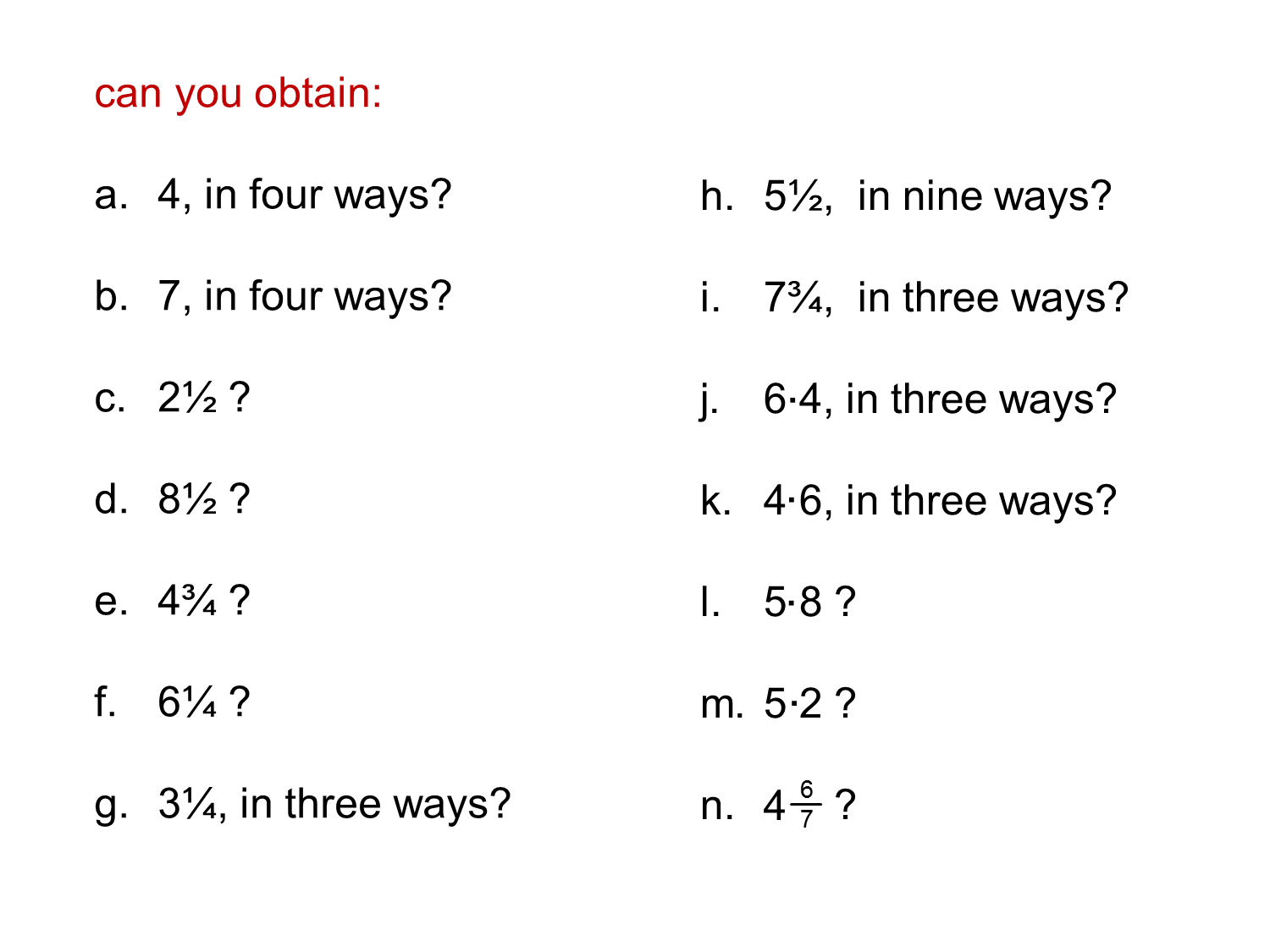
a ppt is here
median
don steward
mathematics teaching 10 ~ 16
don steward
mathematics teaching 10 ~ 16
Showing posts with label linear equations. Show all posts
Thursday, 11 July 2019
Wednesday, 10 July 2019
Saturday, 1 December 2018
equal tops pyramids
these tasks follow an idea of Martin Wilson, of Harrogate, England
the purpose is for students to practice simplifying expressions, within a context
a powerpoint is here
all of the equal top block numbers can be found by trial and improvement and that is the intention, especially for the harder tasks
other techniques can be used
sheet 1 leads to a simple linear equation
sheet 2 leads to a linear relationship that generalises to c = 2n, d = 3n - 4 with top numbers: 6n - 5
sheet 3 can be solved with simultaneous equations, with one solution
sheet 4 leads to a relationship that generalises to a = 2n + 1, b = 3n - 1 with top numbers: 12n - 5
sheet 5 with 3 variables can be generalised to a = 4n - 2, b = 7n - 2, c = 14n - 6
sheet 6 has 4 variables, the smallest equal top number is a triangular number (and you can also make 81 and ...?)
sheet 7 is one that Martin used with his students
they found the smallest possible equal number by finding common terms in the four sequences (which is less than 50) you can also make 209 and ...?
the purpose is for students to practice simplifying expressions, within a context
a powerpoint is here
all of the equal top block numbers can be found by trial and improvement and that is the intention, especially for the harder tasks
other techniques can be used
sheet 1 leads to a simple linear equation
sheet 2 leads to a linear relationship that generalises to c = 2n, d = 3n - 4 with top numbers: 6n - 5
sheet 3 can be solved with simultaneous equations, with one solution
sheet 4 leads to a relationship that generalises to a = 2n + 1, b = 3n - 1 with top numbers: 12n - 5
sheet 5 with 3 variables can be generalised to a = 4n - 2, b = 7n - 2, c = 14n - 6
sheet 6 has 4 variables, the smallest equal top number is a triangular number (and you can also make 81 and ...?)
sheet 7 is one that Martin used with his students
they found the smallest possible equal number by finding common terms in the four sequences (which is less than 50) you can also make 209 and ...?
Saturday, 17 February 2018
directed number arithmogons
the word 'arithmogons' (rather than 'arithmagons') seems to stem from an article by Alistair McIntosh and Douglas Quadling in Maths Teaching number 70 (in 1975)
amongst many other things Leo Moser (1921 to 1970) studied pairs of numbers adding up to totals, including the work in the third resource: pairs of numbers always summing to a square number
the powerpoint goes through various algebraic solution steps - one good reason for studying arithmogons, as well as (in this case) practice with directed numbers
Craig Barton details the reasons he enjoys working with arithmogons and has various tasks based on their structure here
amongst many other things Leo Moser (1921 to 1970) studied pairs of numbers adding up to totals, including the work in the third resource: pairs of numbers always summing to a square number
the powerpoint goes through various algebraic solution steps - one good reason for studying arithmogons, as well as (in this case) practice with directed numbers
Craig Barton details the reasons he enjoys working with arithmogons and has various tasks based on their structure here
Thursday, 1 February 2018
Tuesday, 6 December 2016
expressions quadrilaterals
this idea is due to Martin Wilson in Harrogate
a ppt is here
there is an intention that students start with substitution, including trial and improvement
and then progress to linear equation solving (unknown on both sides)
John Golden has produced some geogebra versions so that the resulting quadrilateral can be viewed for various x values (maybe once the solutions have been ascertained)
related themes are explored in MathsMedicine (professor smudge) - see the various youtube clips on 2D dynamic bar model for an equation e.g. this one
a ppt is here
there is an intention that students start with substitution, including trial and improvement
and then progress to linear equation solving (unknown on both sides)
John Golden has produced some geogebra versions so that the resulting quadrilateral can be viewed for various x values (maybe once the solutions have been ascertained)
related themes are explored in MathsMedicine (professor smudge) - see the various youtube clips on 2D dynamic bar model for an equation e.g. this one
Friday, 11 November 2016
Wednesday, 15 June 2016
so, linear equations
legitimately going from one statement to another (is kind of what maths is about)
deductions
the so... ppt is here
deductions
the so... ppt is here
Thursday, 7 April 2016
regular polygon nesting
based on a UKMT Junior challenge question (April 2015, Q16)
all of the internal polygons are regular and they just touch the equilateral triangle, as shown
find the sum of the two angles indicated (i.e. a + b = ?)
all of the internal polygons are regular and they just touch the equilateral triangle, as shown
find the sum of the two angles indicated (i.e. a + b = ?)
Wednesday, 8 July 2015
Saturday, 6 June 2015
Wednesday, 3 June 2015
rectangle perimeter
perimeter change with area the same
cutting a shape in half - in two different ways
this task is based on a SAT question
(KS3, L4 to L6, year 2000, paper 1, question 14)
congruent rectangles making up a larger rectangle
in two different ways
'P' is the perimeter
find the length and width of the smaller rectangles
cutting a shape in half - in two different ways
this task is based on a SAT question
(KS3, L4 to L6, year 2000, paper 1, question 14)
congruent rectangles making up a larger rectangle
in two different ways
'P' is the perimeter
find the length and width of the smaller rectangles
Subscribe to:
Posts (Atom)