median
don steward
mathematics teaching 10 ~ 16

Showing posts with label gradient. Show all posts

Friday, 19 July 2019

slopes of hills

gradients of steep hills
there was a Guinness record update in July 2019

a powerpoint is here

there are some links (in 'hidden' slides) to youtube clips

there's some difference of opinion about whether it is sinA or tanA (where A is the angle of inclination) that is used as a gradient (slope) measure but it seems (appropriately) to be the tangent of the angle: the elevation distance / horizontal distance

Guinness World Records sets out a definition for the steepest street: the
 maximum gradient over a ten metre span, comparing the vertical rise to the horizontal distance

see the wikipedia entry on grade(slopes) here

the quoted slope on road signs appears to be the steepest section of the road rather than an average slope over the length of it


Wednesday, 13 July 2016

gradient contexts

slides about the gradients of
  • qanads (water channels)
  • wheelchair ramps
  • roof pitches
  • pyramid inclinations
  • stadium seating rake
mainly useful to introduce arc tan (rise / run) to obtain the angle of inclination

Monday, 13 June 2016

stairs steepness

the powerpoint is here

this task is based on an idea from Malcolm Swan and Jim Ridgway

Fawn Nguyen writes about using these resources here


some scale drawings of staircases are shown

students write down the letter of the staircases
in order of their steepness (most down to least)

without using any form of measuring device, initially anyway
they then consider how they might measure the steepness to check whether their order is reasonable or not

what could they do if protractors are not available?


Thursday, 31 March 2016

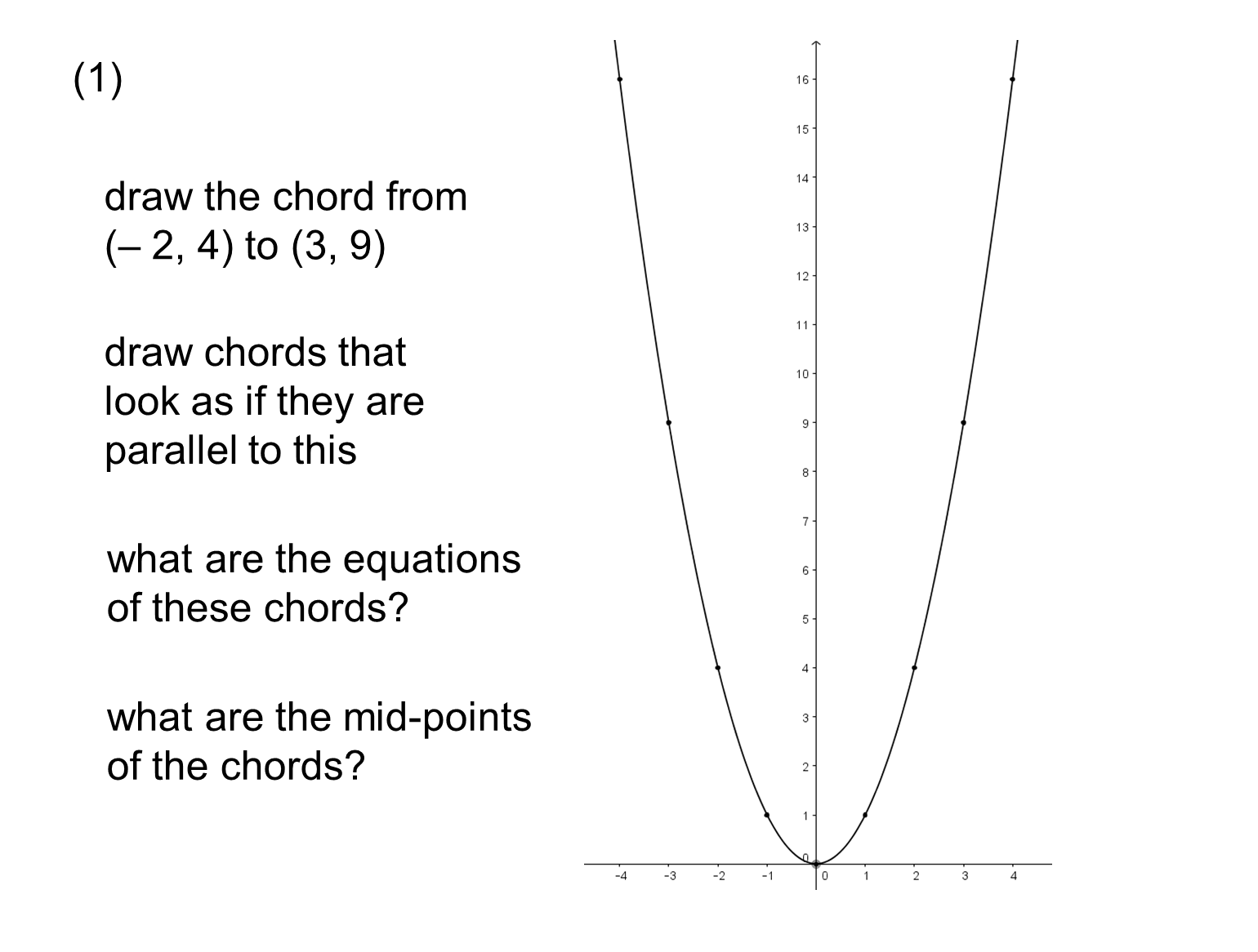
quadratic graph properties

some of the properties of  y = x ^ 2
only considering integer points

work developed with David Wells

a ppt is here

several interesting applications of:
  • straight line graphs (the chord equations are all neat)
  • mid-points
  • tangents (are parallel to a family of chords)
  • perpendicular line equations


Monday, 28 March 2016

right trapeziums

the Ancient Babylonians (up to 4000 years ago) appear to have worked substantially with right-angled triangles and right angled trapeziums

one of their many clever techniques is that of being able to split a right-angled trapezium into two equal areas (seemingly for inheritance purposes - with fields and orchards)

in a study reported early in 2016, Mathieu Ossendrijver claimed to show that the Babylonians had tracked the path of Jupiter


one of the techniques involved in this calculation involved splitting a right-trapezium into two equal areas

splitting a right trapezium into two equal areas is a difficult problem

initially, consider the simpler problem of finding the length of a line part way along a right-trapezium

using 'steps': the Babylonians had an understanding of (what gets translated as) 'feed': how much you go down (or up) for a certain distance across
(i.e. the tan of the angle of depression)


in some of these questions the line does split the area in two

which?


for a base split in the ratio 1 : 2
how do you find the length 'n' ?


how do you do this in general?


turning to the much harder problem of how to dissect the area, just for the case where the base ratio is 1 : 2


using the result previously obtained for the distance 'n' being the weighted mean of 'a' and 'b' in the ratio 1 : 2
using the areas of the trapeziums
left = right

(or you could also use e.g. left = half of the whole)


Wednesday, 30 December 2015

straight line graphs and nth terms

maths GCSE questions (mostly based on WJEC past papers)


Friday, 11 April 2014

mistrusting diagrams

students probably need to know that diagrams aren't always trustworthy...

they can be asked to establish what is wrong with these diagrams that lead either to a missing area or an extra area after a dissection and a rearrangement

youtube clip

four variations on a theme:


what is wrong with these?
plus a chocolate generating device:


sometimes called the 'Tarski-Banach' paradox