median
don steward
mathematics teaching 10 ~ 16

Showing posts with label factors. Show all posts

Sunday, 29 October 2017

cancelling fractions

maybe slightly too many questions....
(not using a calculator, especially a scientific one, unless it's to check results)


the equivalent fractions below
involve all of the digits, 1 to 9

there are several more 1 to 9 versions for some of the fractions

reference: ben vitalis at fun with num3ers
many thanks to him

practice at multiplying and dividing


there is another one for a third


Saturday, 8 July 2017

a number puzzle

some developments of a number puzzle


Sunday, 3 July 2016

factors of numbers and number of factors

once the prime number decomposition of a number has been identified, there are reasonably straightforward rules for deciding how many factors a number has

using facts such as a prime cubed has four factors

the powerpoint for this


Saturday, 6 December 2014

product puzzles

some students might notice that e.g. in question (1) 3 times 10 is the same as 6 times 5 


what happens to the factors to generate an alternative solution (where there is one)?


Sunday, 18 May 2014

1 to 9 multiplied

the idea for this (and the first question) is from nrich 1134

thinking enables the (usually unique) solutions to be found


also see: NRICH multiplication equation sudoku

Saturday, 21 December 2013

repeated factor sums

looking at the sum of the factors (apart from the number itself) leads to a study of abundant, deficient and perfect numbers

starting with the number 30

list all of the factors apart from the number itself and then sum these factors (positive proper divisors or aliquot parts)


do the same thing for this new number
and keep going:

30 ~ 1 + 2 + 3 + 5 + 6 + 10 + 15 = 42
42 ~ 1 + 2 + 3 + 6 + 7 + 14 + 21 = 54
54 ~ etc...

this gives an interesting sequence of numbers which increases in a steady pattern for a few terms (six altogether)

reasons for this aren't too difficult to consider (based on the number 6)

30 ~ 1, 2, 3, 6,     5, 10, 15
42 ~ 1, 2, 3, 6,     7, 14, 21
etc...

can similar 'runs' for other starting numbers be found?

what happens if you start this process with 28?

Tuesday, 11 June 2013

hollow square

in Napoleonic and other battles a hollow square was a popular formation for an infantry battalion e.g. Wellington's army at Waterloo, to cope with cavalry charges


not Wellington's army...


a recreation of Wellington's army hollow square formations


for a battalion (normally between 700 and 1200) of 960 soldiers, how many possible hollow square arrangements are there?
state the widths for each

if you want to start off with an easier number of people, find the 3 options for each of:
  • 48
  • 45
  • 80 
and the 4 options for 96

in order to do this you will need to find a pair of odd factors or a pair of even factors
they need to be 'compatible' to avoid halfs

e.g. for 48, you could use 6 x 8
and then use the difference of two squares, putting a - b = 6 and a + b = 8

45 is the smallest odd number that can be expressed as the difference of two squares in three different ways (not allowing zero)
and 48 is the smallest even number

960 soldiers in a hollow square formation have many options,
10 (I'm fairly sure)
e.g. 24 x 40


Sunday, 16 December 2012

number image

representations of numbers according to their factors from 'datapointed'
this was done by Stephen Von Worley working with and on Brent Yorgey's initial diagrams, showing the various factorisations

see also an earlier post (prime number images)

Thursday, 5 April 2012

factor trees


nudging towards the fundamental theorem of arithmetic
(and maybe to provide a reason why 1 is not considered to be a prime number any longer)
this can be done with or without this sheet
[e.g. pose the task of finding all the ways that 90 can be broken down]


what are the missing products?


factor trees drawn by students in Y5 at the International School of Toulouse
see pinkmathematics
what are the missing numbers?


find a way to break down 720 into a product of prime factors that fits this tree:

Sunday, 11 September 2011

Thursday, 8 September 2011

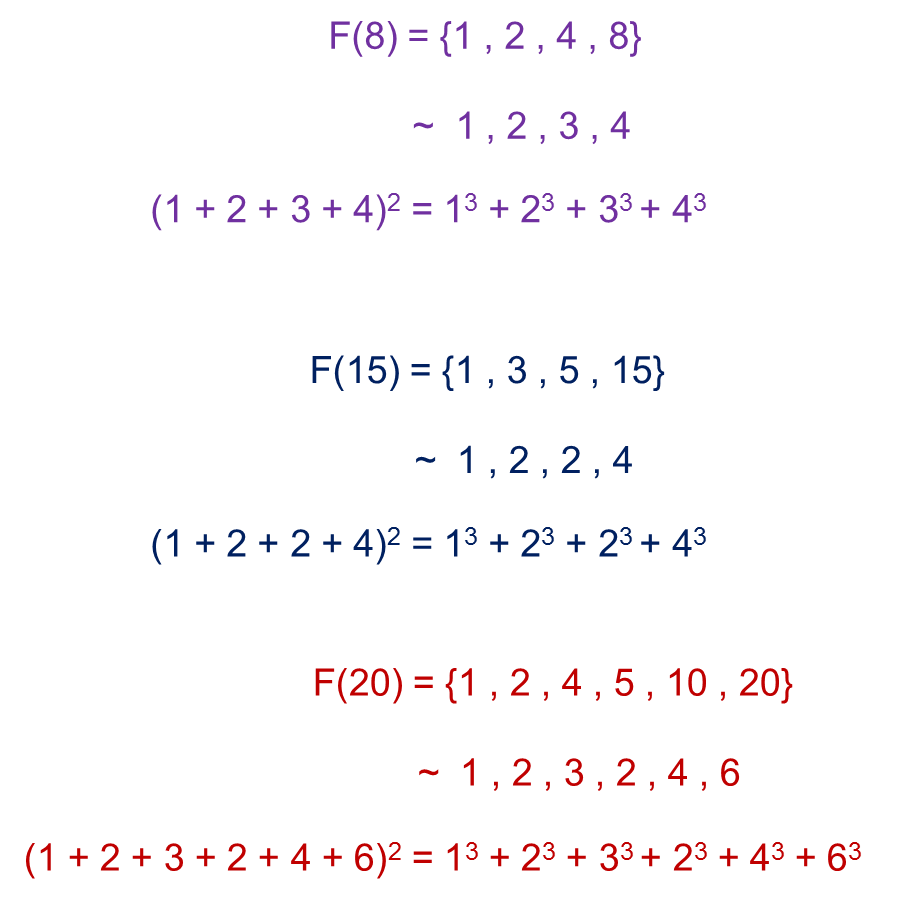
a factoring rule

This was one of Joseph Liouville's simpler theorems (1809 - 1882)

write out all the factors of a number
then write the numbers of factors for each of these factors
the sum of these squared = the sum of the cubes of these

Thursday, 1 September 2011

remainders

what numbers have a remainder of 1 when they are divided by 3?

what numbers have a remainder of 1 when they are divided by 2 or by 5?


what is the smallest number so that:

when it is put into bunches of 3
there is 1 left over

when it is put into bunches of 5
there is 2 left over

when it is put into bunches of 7
there is 3 left over?


    there is a similar problem that was brought to my attention by David Wells, seemingly offered by Sun Tsu-Ching who worked on the Chinese remainder theorem (around the 4th century CE - I like the idea of students working on similar problems to their ancient ancestors):
    • when you divide a number by 3, the remainder is 2
    • when you divide it by 5, the remainder is 3
    • when you divide it by 7, the remainder is 2
    can students find the smallest and then the next biggest numbers?