median
don steward
mathematics teaching 10 ~ 16

Showing posts with label being systematic. Show all posts

Sunday, 20 October 2019

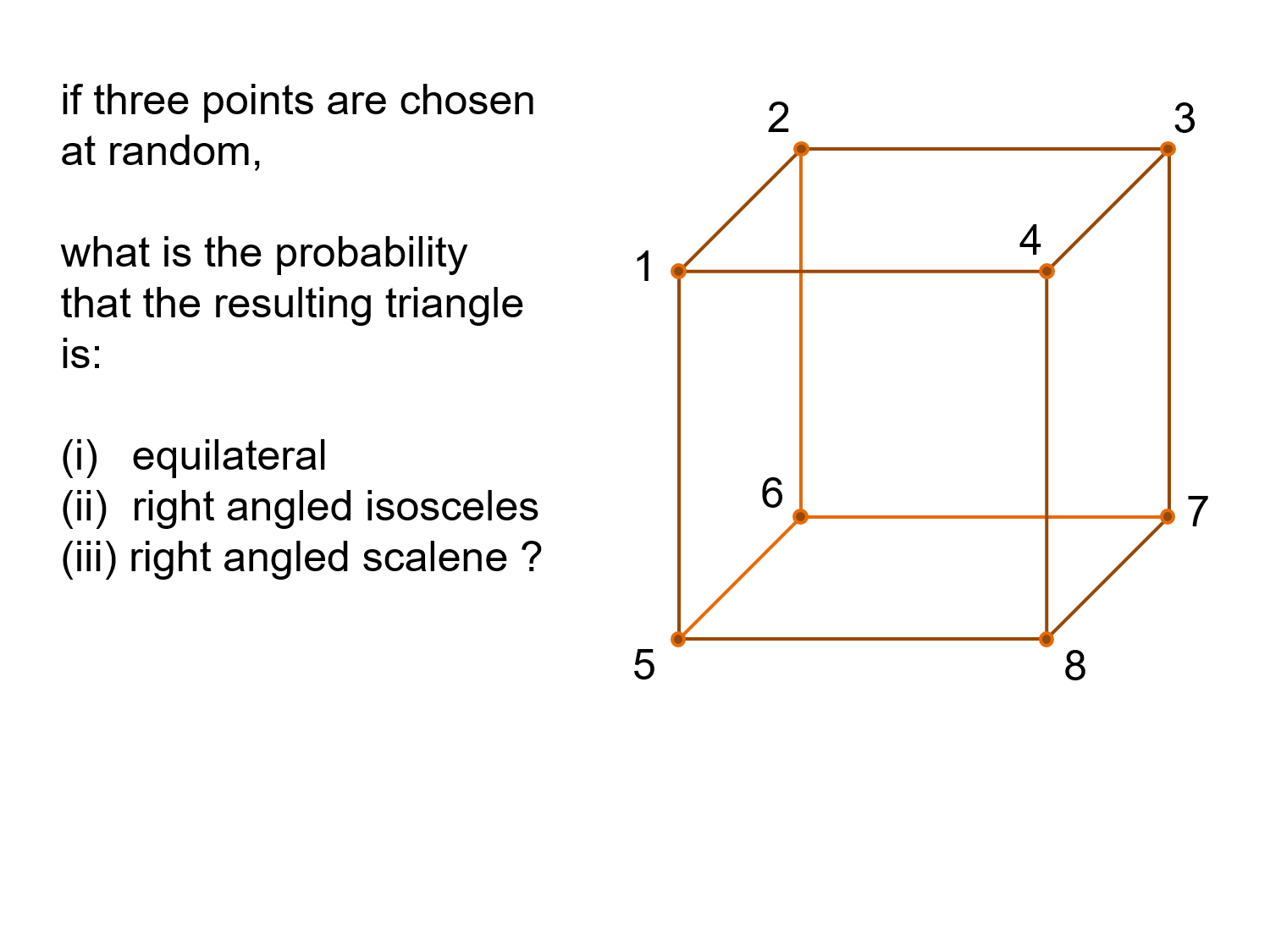
framework of a cube

the idea for this comes from 'mental gymnastics' by dick hess

a ppt is here


what are the lengths?


the lengths of 1 are the edges of the cube
the lengths of root 2 are on the faces, 2 on each
the lengths of root 3 connect the corners of e.g. the top face to the opposite corner of the lower face

28 lengths altogether (which is 8 choose 2)

only 3, perhaps surprisingly


56 triangles altogether = 8 choose 3
but you could, without loss of generality, have 1 as the first corner to obtain the (correct) probabilities



what is intriguing is that the numbers of different lengths
match the numbers of different triangles
there may be a good reason for this (but I can't see it!)

Sunday, 8 January 2017

quartering a 5 by 5 grid

hopefully being systematic, using some logic/reasoning, students can look to find all the ways to
quarter a 5 by 5 dotty grid with
(i) rotational symmetry order 4
(ii) rotational symmetry order 2
(iii) one line of symmetry

they could also find all 13 ways to half a 4 by 4 grid

the powerpoint for this


Saturday, 9 February 2013

systematic counting of triangles

more complicated to keep track of than 'rectangles in a rectangle', this fairly well known puzzle:

to count the total number of triangles in this shape (usually with three lines from each lower vertex rather than the two shown here)


has been cleverly analysed by Ethan Siegel

and has an easy to recognise generalisation


students can think about ways to systematically count all the options

[in his blog article, Ethan highlights several incorrect methods that he has found]


Ethan proposes considering each node in turn, up from the bottom one so that all new triangles are counted and none are counted twice:


1 + 2 + 3
2 + 3 + 4
3 + 4 + 5


with differing numbers of additional lines, clear patterns can emerge:


David Wells, also cleverly, shows how this problem relates to that of counting the number of rectangles in a rectangle:

systematic counting of rectangles

a bit of systematic counting is helpfully encouraged in the subject

I like this task because it has a neat generalisation and reasons for this can be explored
and linked to 'combinations' at some suitable time


Saturday, 22 December 2012

reduction multiplication


some other questions:
  • what is the largest number with an odd number root? 
  • what is the common property of numbers that give an odd number root and why
  • how nany numbers are there with an odd root?
  • what happens to numbers with a 5 in them?
  • by working backwards, find all of the 33 numbers that have a root of 5
this task is presented as 'Fossils' in 1000 problems (thanks to Puntmat for locating this for me - I had forgotten)