median
don steward
mathematics teaching 10 ~ 16

Showing posts with label forming equations. Show all posts

Friday, 29 November 2019

Saturday, 2 February 2019

ratio possibly with algebra questions

some demanding ratio questions that are used or adapted from recent GCSE papers and some from the additional/further maths papers

opinions differ on how to teach approaches to these sorts of questions
all can involve algebra (a relatively unthinking and so, for me, safer way) but can also be done by considering e.g. lowest common multiples with the part (or whole) that does not change and then appropriate scaling (equivalent ratios)

the powerpoint is here


you can solve these questions by listing equivalent ratios (scaling)

and seeing which 'works'


these considerations can be sped up by considering the lcm of what does not change, in this case the number of blue beads (thanks to Richard Trimble)


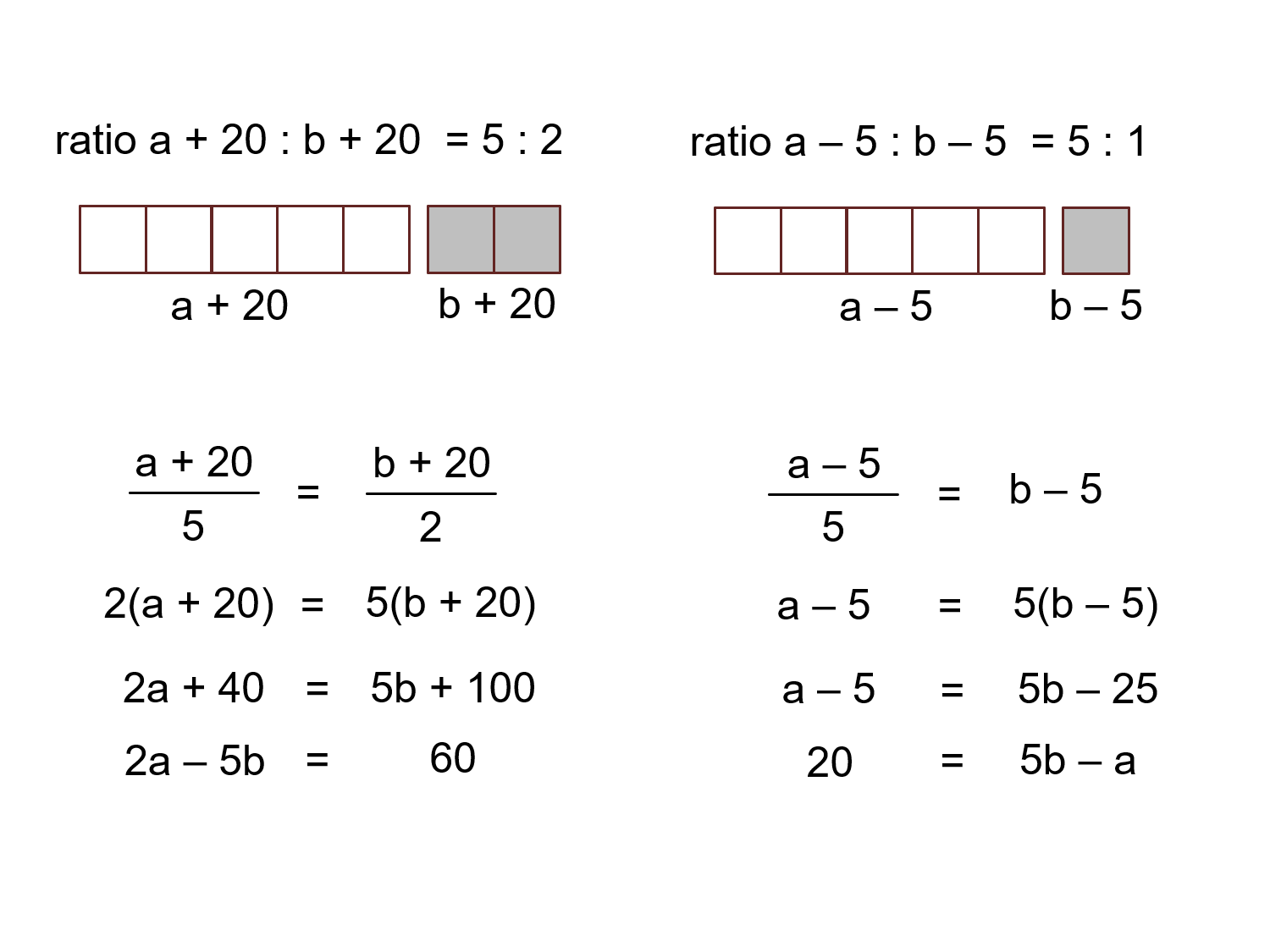
a bar model might help (even if only retrospectively...)


and then consider what fraction the extra 5 must be of the original red bar

or students might prefer to use an algebraic technique

involving simultaneous equations:


or, setting up an equation and cross-multiplying:


the course AQA 8360 has involved questions like ratio (iii)


show that the second statement follows from the first


Wednesday, 23 May 2018

equations with arithmetic and quadratic sequences

these resources are from Jason Steele, Barnsley
they are based on Martin Wilson's idea


Friday, 8 December 2017

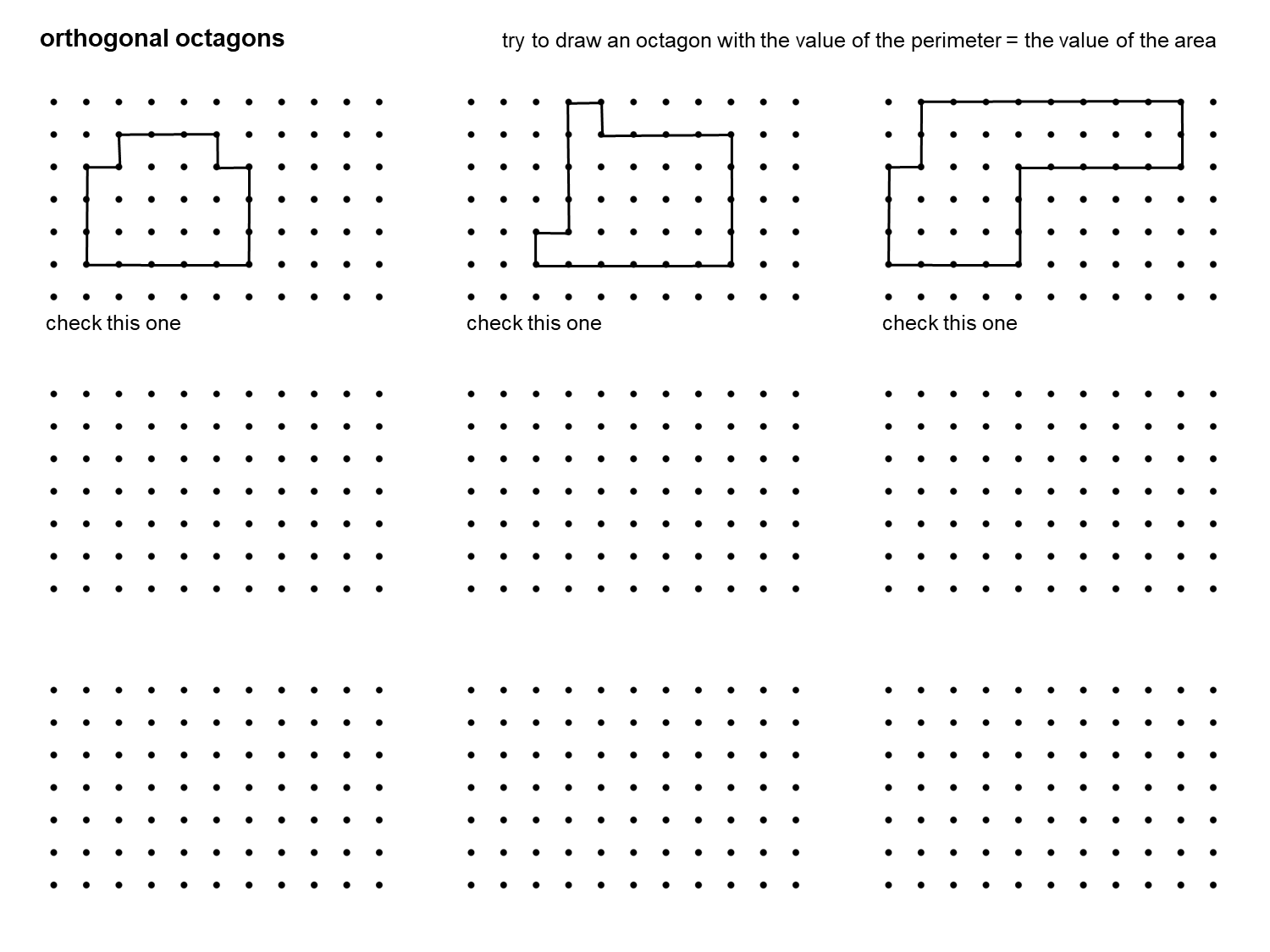
equable orthogonal octagons

an equable shape has the same value for the area as for the perimeter
set up an equation
from A = P
and solve it

maybe consider different ways to chop up the octagons to ascertain their areas

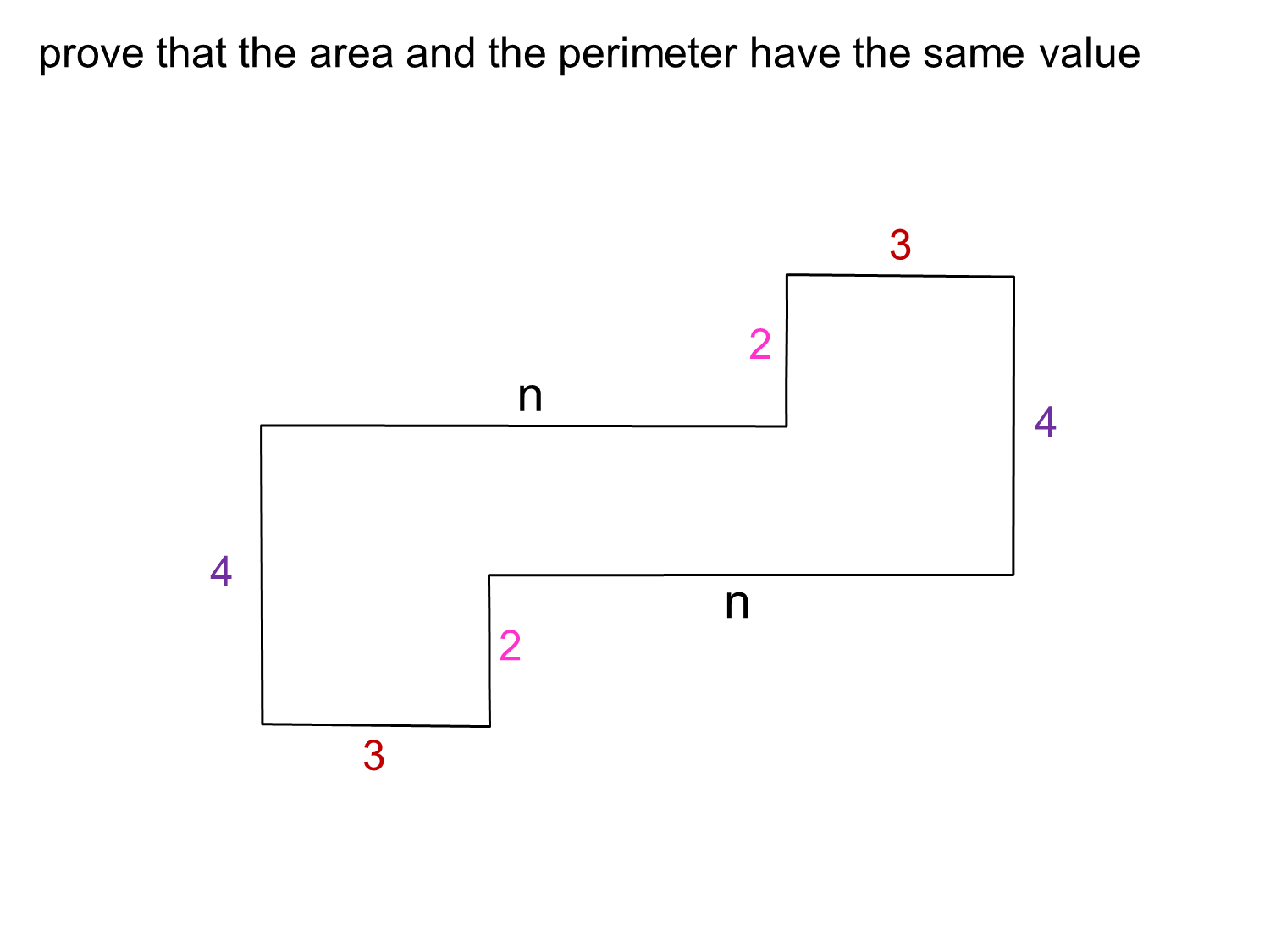
equable orthogonal hexagons

an 'equable' shape has the same value for the perimeter as the value for the area
this work can involve setting up and solving linear equations and forming linear relationships
and generalisations (that can be proved)

an orthogonal polygon just has right angles and 270 degree angles (that I like to call 'left' angles) inside it

[sometimes these are called 'rectilinear polygons'
but 'rectilinear' idetifies shapes that are 'bounded by straight lines' rather than those involving multiples of 90 angles]


Monday, 20 November 2017

equable shapes

'equable shapes' can be an interesting study

these resources practice finding areas and perimeters of common and compound shapes, leading possibly to solving equations

the powerpoint is here

for rectangles, it can be beneficial to appreciate the function/relationship by looking at a full range of values (not just integer values, as is usually a restriction for equable shapes)

the values for 'a' are selected so that the corresponding values for 'b' can be calculated, maybe without a calculator
and a graph of (a, b) values could be plotted - or at least considered


Friday, 11 November 2016

puzzle square

I liked the puzzle posted by Jonathan, brought to my attention through Jo's resources


this puzzle involves one minus sign

for all pluses and all minuses between the boxes there are infinitely many solutions
but the one minus (a) and (b) and three minuses (c) versions lead to some interesting results

students can find solutions by trying out numbers and then adapting

resources (b) and (c) are intended as directed number practice

a powerpoint shows how algebra can be involved
(download it for the animations to work)