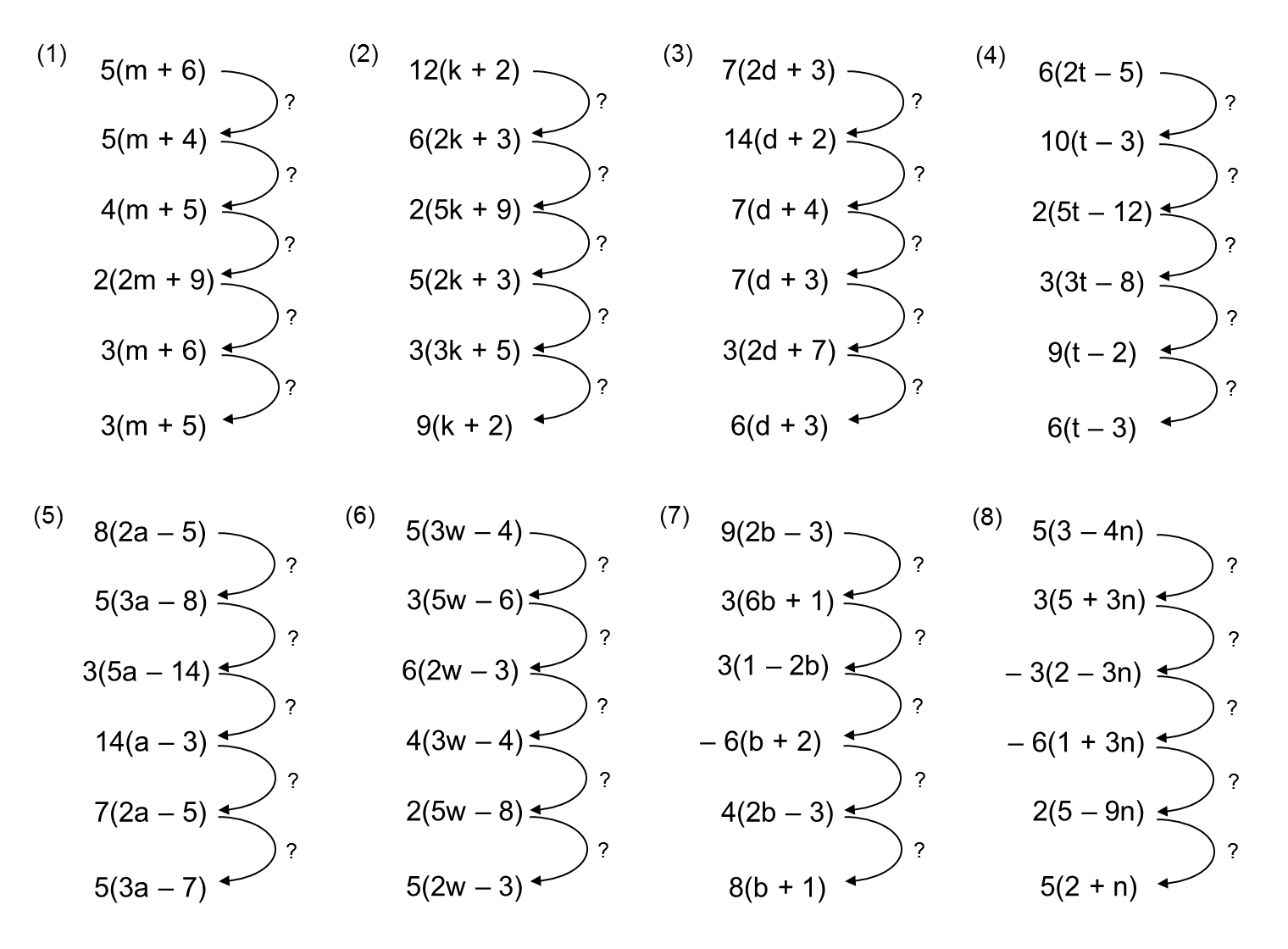
the powerpoint is here
(download for the animations to work)
it's a good way to introduce expressions, with some conventions for writing a sequence of operations as an expression and then manipulating such algebraic expressions

"try some simple numbers then some harder ones - maybe big numbers, fractions, decimals, negative numbers"
for integer inputs, by looking at the output numbers, students can find a 'short cut' rule
this is helped by the output numbers all being even
"what happens?"
rather than needing 3 operations you can use a 'shortcut', of two operations

in this case the shortcut is x 2, + 2
or (deliberately designed to have an alternative)
+ 1, x 2
students can then explore a shortcut rule using 'm' for a million, 'b' for a billion etc. as an input number
here's the script:
"let's check out the rule (shortcut of x 2, + 2) for a really big number"
"what's a really big number?"
"no, 3425 is too small"
"OK, a million is good - how many noughts in a million?"
"oh, that's too big, I think I'll just write 'm' for a million"
"a million (m) add 3 is?"
[m + 3] sometimes they say m3 to which you appeal to worldly conventions
"then multiply by 2 is?"
[2m + 6]
"subtract 4 is?"
[2m + 2]
"does this fit with the rule?"
"why is this the same as + 1 then x 2?"
this encourages writing expressions in an appropriate manner
later work can involve using an expression as an input e.g. 3m + 2
other sets of three (or more) operations can be introduced:

and shortcuts established:
x 5 then + 10
or
+ 2 then x 5