median
don steward
mathematics teaching 10 ~ 16

Showing posts with label quadratic rules. Show all posts

Friday, 14 October 2016

optimisation problem

the question is very similar to one set by SQA (Scotland) in may, 2015
students could tackle the question using calculus but that is not the intention here

it is to build up a formula and substitute values into the formula to find a minimum

a ppt is here


Saturday, 8 October 2016

quadratric sequences

intending to familiarise students with the properties of a growing quadratic sequence
rather than finding a quadratic rule from a (given) procedure

the second resource was suggested by David Wells
intending to explore the differences - possibly by students looking at a few quadratic rules to discover generalities for themselves

you might choose to just use the second resource
hopefully students will appreciate the symmetry of some sequences

possibly exploring when a growing quadratic sequence has symmetry and when it has not


Saturday, 27 September 2014

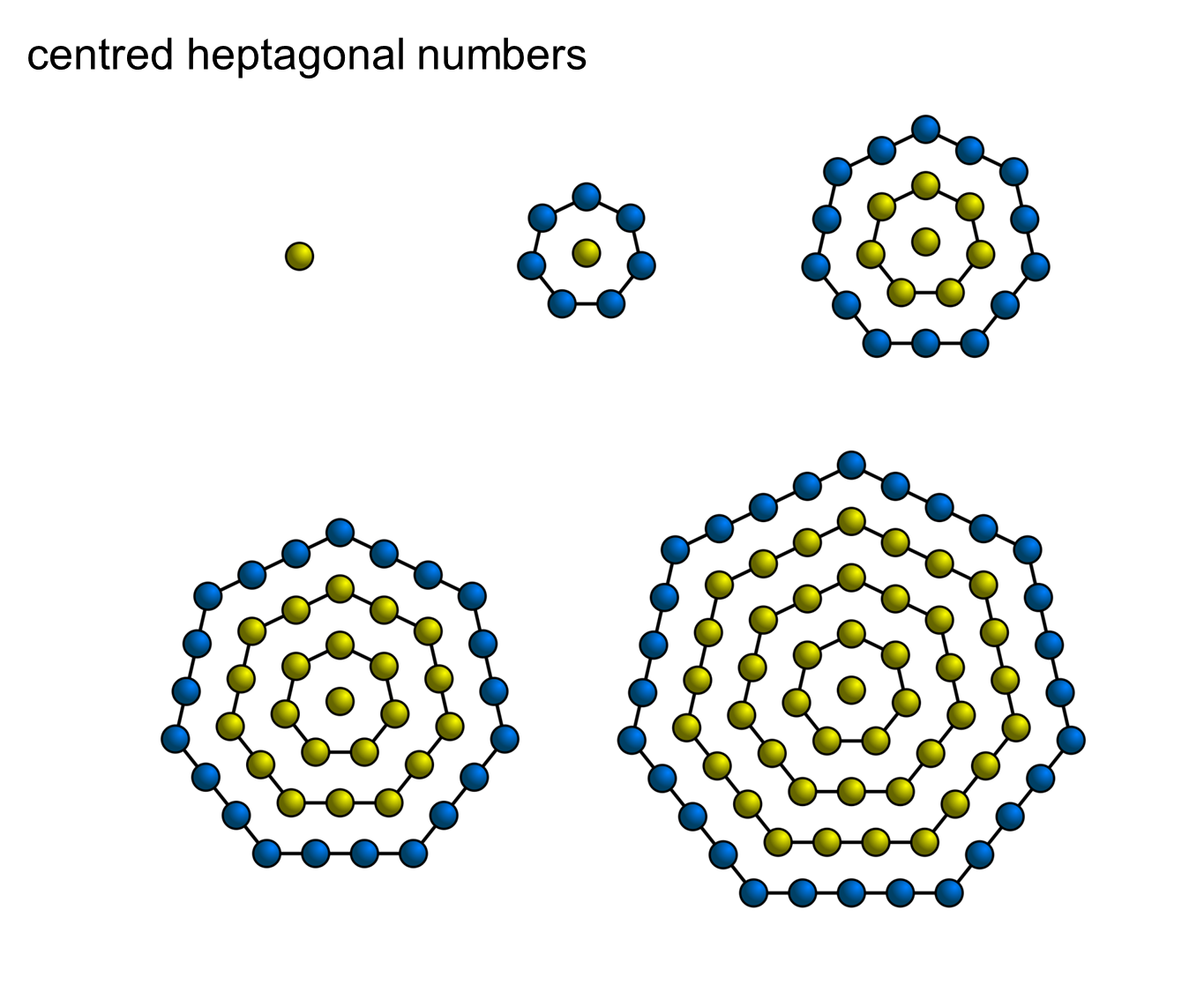
centred polygonal numbers

the Ancient Greeks took to exploring number patterns derived from shape arrangements - possibly pebbles in the sand
Hypsicles of Alexandria (around 170 BCE) seems to have been one of the first
followed by Theon of Smyrna, Nichomachus and (reported at least in) Plutarch (around 100CE)

this work might be used to focus on number patterns but also could involve:
  • developing quadratic nth terms
  • solving simultaneous equations in 3 unknowns
  • proof, involving triangular numbers

these resources focus on the centred polygonal numbers
a geogebra version with sliders


pictures created by Stefan Birkner


pictures created by Claudio Rockini


Friday, 7 March 2014

quadratic generalisations


 a version for (a)
an alternative version for (a)
a version for (b)
another version for (b)
a general rule for (c)


a rule for (d)


another rule for (d)

Friday, 29 March 2013

windpower

image from Case Western Reserve University


try to fit a function to the data
predict the output for a 252m blade
give reasonable values for 112m and 126m blades


try to fit a function to this Vestas turbine data

Friday, 17 February 2012

linear & quadratic growths

it can be helpful to provide students with two tasks that involve (i) a linear and (ii) a quadratic generalisation - so that they might better appreciate some of the reasons for these rules                     

a one dimensional (length) growth results in a linear nth term
two dimensional (area) growth results in a quadratic nth term


you can ask some of the beneficial 'growing shapes' questions:
  • what will the next one/two look like?
  • how would you describe the growth pattern to someone?
  • if you were asked to count the squares, how might you do so?
what seems neat about this task (above, though not the one below) is that both generalisations are not too demanding (on a good day) and, as students do observe, the first sequence 'loops' fit together, Russian doll like to create the second sequence

this can lead to a generalisation that sigma (8n) is 4n^2 + 4n and hence to a rule for the sum of the first 'n' natural numbers

the second task is one provided by Mimi Yang on her blog

it might be worth noting that both the above and this linear growth sequence diagrams can be reformed into hollow rectangles


students might be able to give reasons for the linear growth rule                                                              involving 6 as a multiplier rather than 8 in the previous task

they might be able to see a way to 'reform' the second generalisation diagrams to identify the sum of two of the same square numbers

Friday, 23 December 2011

rosettes

call 'rosettes'
a number of circles that overlap as much as is possible...
with n (circles) = 3,
r (regions) = 7


n = 4
r = 13


n = 8
r = 57


in general?
why?


if you focus your attention on the 'swirls' then each of the 8 of them has 7 regions creating
8 x 7 + 1  (the middle) altogether


Friday, 22 July 2011

quadratic growing rules (i)

growing in two directions, across and up, (quadratic) sequences

a ppt is here

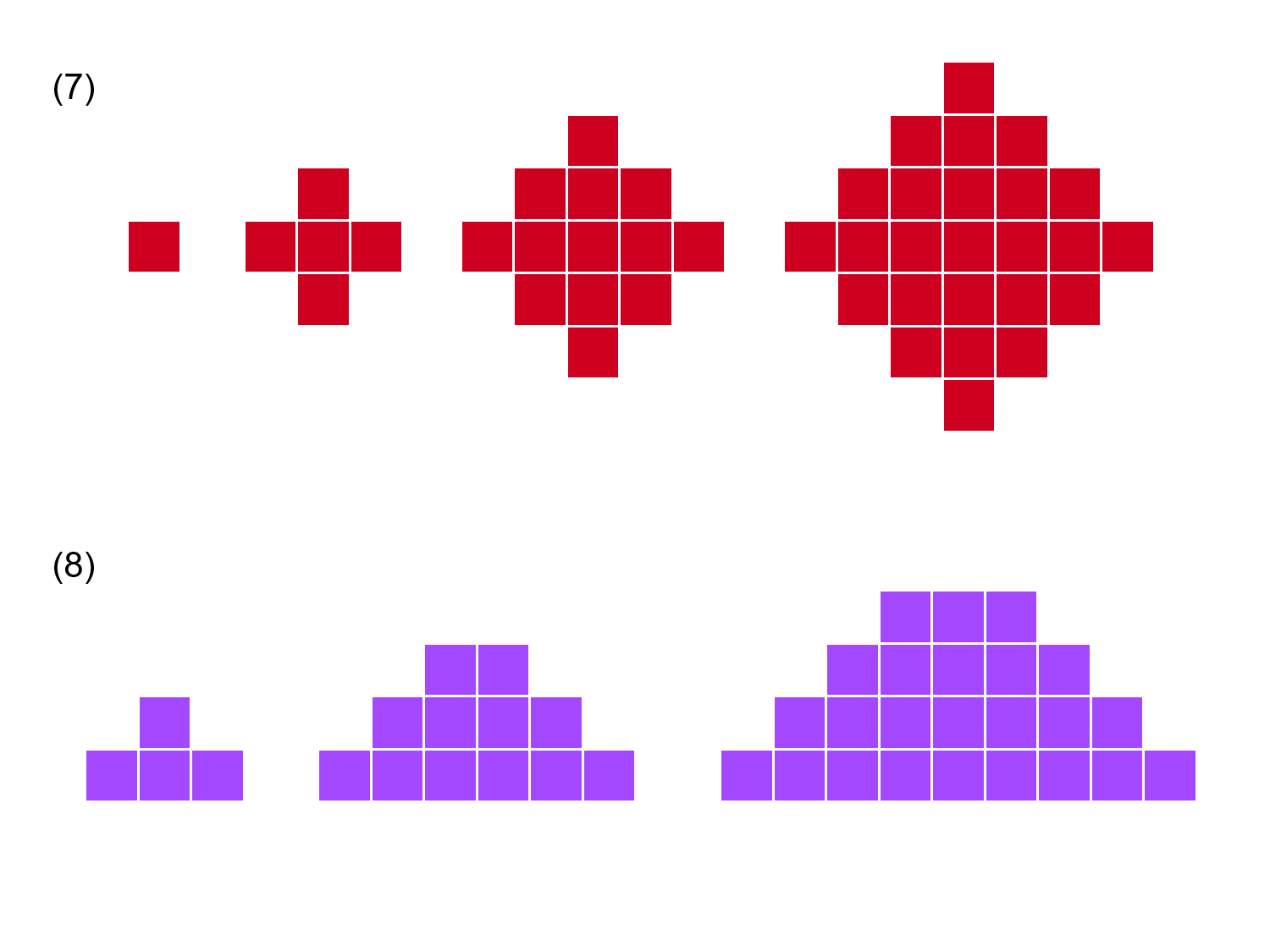
the growing sequences of shapes
have a quadratic nth term form

general rules can be established from the diagrams directly and also from factor pairs (they can be reformed into a rectangle)

or by other, algebraic methods...


part of the interest in generalising these growing sequences is in relating apparently different rules, from various 'viewings' of particular cases - that seem 'regular'

for example, question (4) above can have various nth term generlisations from different viewings: