all due to David Wells
proofs could involve expanding brackets and simplifying expressions
or use the difference of two squares equivalence
or could be considered by using diagrams
median
don steward
mathematics teaching 10 ~ 16
don steward
mathematics teaching 10 ~ 16
Showing posts with label expanding brackets. Show all posts
Friday, 29 November 2019
Thursday, 20 June 2019
Monday, 18 May 2015
Sunday, 17 May 2015
Saturday, 3 January 2015
multiple proofs
intended to lend some purpose to expanding and factorising...
maybe more interesting for students to create their own versions after a while
they could substitute a few numbers into the expressions to check that the statements seem to hold
maybe more interesting for students to create their own versions after a while
they could substitute a few numbers into the expressions to check that the statements seem to hold
Tuesday, 30 December 2014
Saturday, 6 December 2014
Wednesday, 19 November 2014
Wednesday, 29 May 2013
equivalent things
the intention of this first resource is that students substitute the given input values
and then, maybe with some nudging, appreciate that there are shorter rules that give the output numbers from the input numbers
and that these simpler expressions can be obtained by cancelling the algebraic fraction
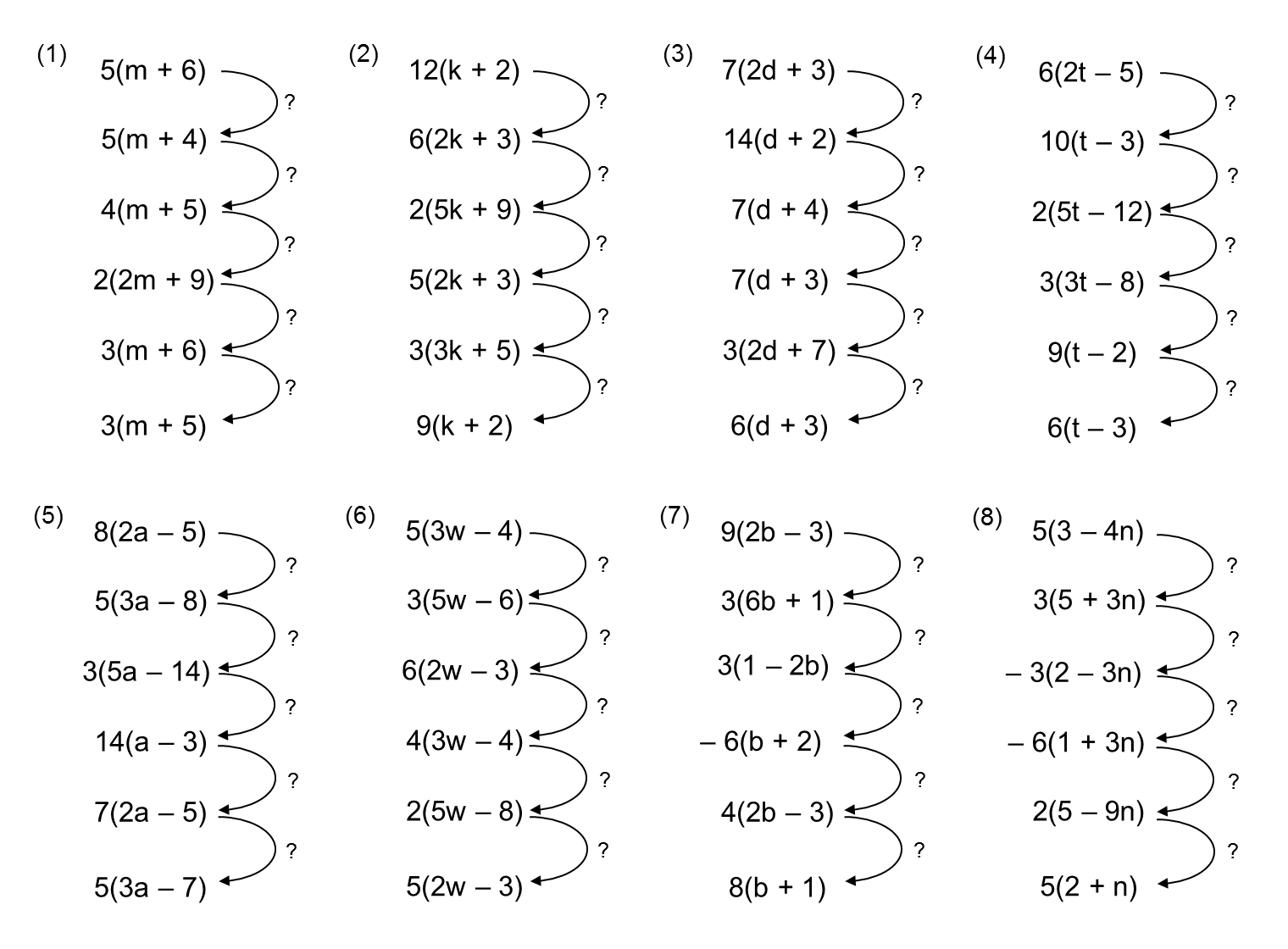
the following resources involve justifying then creating equivalent ('same only look different') expressions to the one in the middle
students can be asked to create their own expressions or versions
and then, maybe with some nudging, appreciate that there are shorter rules that give the output numbers from the input numbers
and that these simpler expressions can be obtained by cancelling the algebraic fraction
the following resources involve justifying then creating equivalent ('same only look different') expressions to the one in the middle
students can be asked to create their own expressions or versions
Tuesday, 9 August 2011
Eudoxus' ladder
Eudoxus of Cnidus (now the tip of SW Turkey) was a renowned mathematician (amongst other things) who lived around 400 BC
one of the methods he (reportedly) developed or adopted when studying irrationals was to use a number series (called his 'ladder') in order to approximate to the square root of 2:
how is the 'ladder' formed?
how can it be used to approximate to the square root of 2?
'Reaching the Core of AS Mathematics', available from the ATM, interestingly links this blended recursion 'ladder' to the expansion of:
work out and simplify this expression for n = 2, 3, 4 etc
what has it got to do with Edoxus' ladder and why?
in the limit,
how does this provide an approximation to the square root of 2?
one of the methods he (reportedly) developed or adopted when studying irrationals was to use a number series (called his 'ladder') in order to approximate to the square root of 2:
how is the 'ladder' formed?
how can it be used to approximate to the square root of 2?
'Reaching the Core of AS Mathematics', available from the ATM, interestingly links this blended recursion 'ladder' to the expansion of:
what has it got to do with Edoxus' ladder and why?
in the limit,
how does this provide an approximation to the square root of 2?
Tuesday, 15 March 2011
Saturday, 13 November 2010
Subscribe to:
Posts (Atom)