median
don steward
mathematics teaching 10 ~ 16
don steward
mathematics teaching 10 ~ 16
Showing posts with label multiples. Show all posts
Tuesday, 2 July 2013
Sunday, 13 May 2012
Thursday, 22 December 2011
equipped
rulers cost 45p
and ballpoint pens cost 35p
someone wants to buy some rulers and some pens (at least one of each)
they have £5 to spend
if they spent these amounts, work out how many of each they bought:
two answers can be found for questions 1 and 3 if zero is allowed
and ballpoint pens cost 35p
someone wants to buy some rulers and some pens (at least one of each)
they have £5 to spend
if they spent these amounts, work out how many of each they bought:
- £4.95
- £5.00
- £4.90
- £4.75
two answers can be found for questions 1 and 3 if zero is allowed
Friday, 7 October 2011
prime sum
thanks to Brent Yorgey
note: this was only an intersting answer if you did it in the year that it was set!
maybe set students the task of finding a prime sum for one of the forthcoming years
Wednesday, 15 June 2011
a multiple number
what is the smallest number such that when you
- subtract 4 from it you get a multiple of 4,
- when you subtract 5 you get a multiple of 5
- when you subtract 6 you get a multiple of 6?
Thursday, 21 April 2011
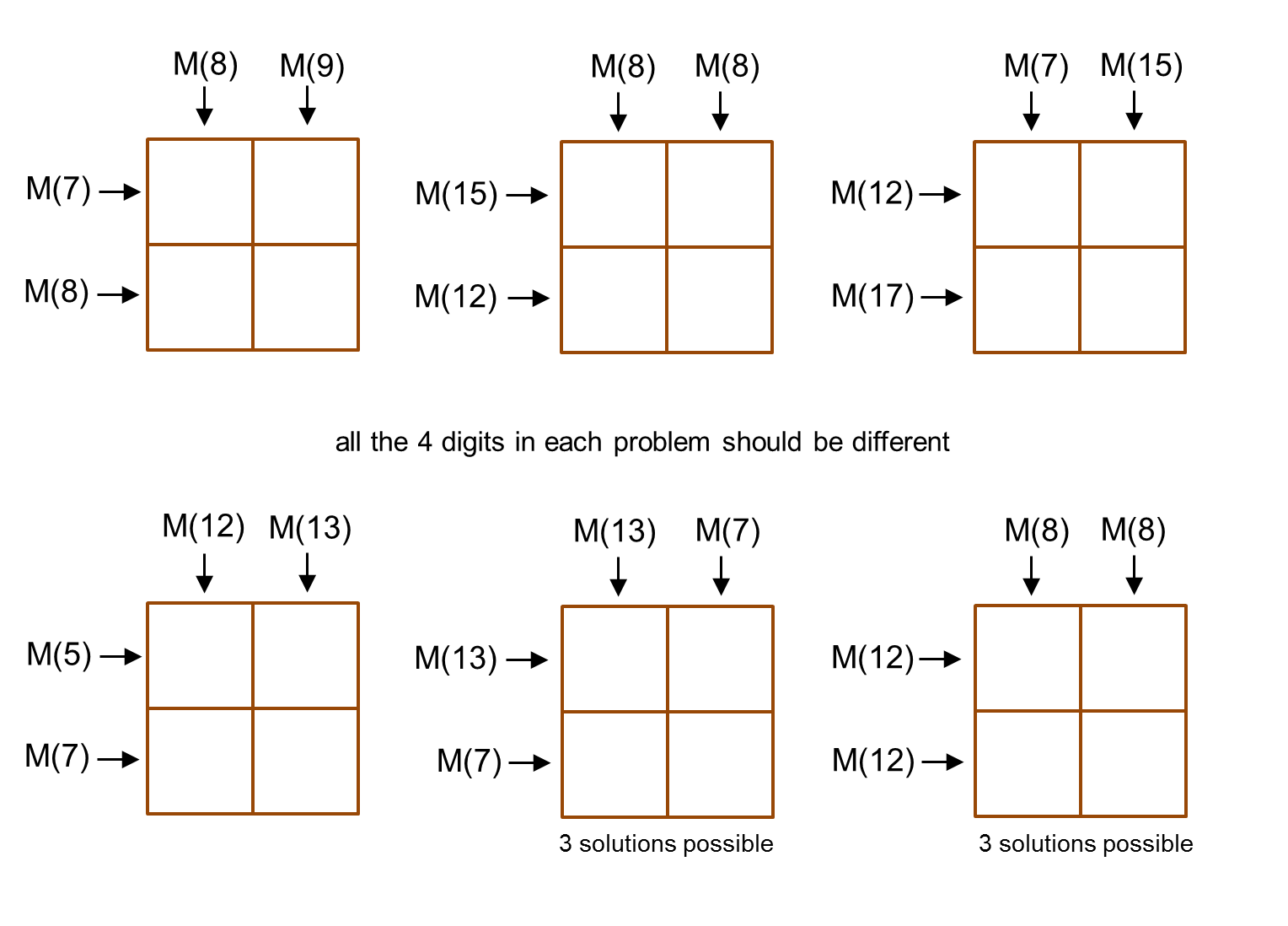
multiple puzzles
M(15) means the number must be a multiple of 15 i.e. 15 or 30 or 45 or 60 or 75 or 90
find four digits (all differenet) to go in each of the boxes to make 2-digit multiples of the required number when you read across and down:
Monday, 11 April 2011
factor links (factorgrams)
an arrow means that a number divides exactly into another number ('is a factor of')
in this work it needs to be fairly often repeated that all the arrows that can be drawn have been drawn
so you cannot have a number that divides into another without there being an arrow to show this
start off with students drawing the arrows themselves:
draw all the arrows that you can to show the relationship 'is a factor of'
note that for question (1) you cannot use e.g. 3 and 6 since there is no arrow between the two blank circles (i.e. one must not be a factor of the other)
for this reason, you should not use 1 or the number itself
Wednesday, 16 March 2011
Sunday, 2 January 2011
Sunday, 19 December 2010
multiples of 36
using 5, 6 and 7 as three digits of a four digit multiple of 36,
find the largest and also the smallest (4-digit) number
[you should find that the difference between them is 4680]
can you also find a multiple of 36 with three 8s in it?
[ this problem was posed by Tony Gardiner ]
find the largest and also the smallest (4-digit) number
[you should find that the difference between them is 4680]
can you also find a multiple of 36 with three 8s in it?
[ this problem was posed by Tony Gardiner ]
Tuesday, 21 July 2009
subsets
test out this rule:
the numbers can be as easy or tricky as you like (and could be negative)
e.g. 7 6 4 14 6
6 + 14 + 4 = M(3) and also:
6 + 7 + 14 = M(3)
a proof can be developed from a consideration of remainders after dividing by 3 (i.e. mod 3 arithmetic) and a consideration of the various options
also prove that in any 3 integers you can find two that sum to an even number
in any 6 integers you can find four that sum to a multiple of 4
for any 5 integers you can always find three of them
that add up to a multiple of 3
the numbers can be as easy or tricky as you like (and could be negative)
e.g. 7 6 4 14 6
6 + 14 + 4 = M(3) and also:
6 + 7 + 14 = M(3)
a proof can be developed from a consideration of remainders after dividing by 3 (i.e. mod 3 arithmetic) and a consideration of the various options
also prove that in any 3 integers you can find two that sum to an even number
in any 6 integers you can find four that sum to a multiple of 4
Thursday, 30 April 2009
Ben's game (not the video game about fighting cancer)

this problem is on the NRich site where there are detailed teaching notes
unfortunately their version only has one solution, so once students have found this solution they need something else to do...
the version here is slightly older (due to Diophantus ~ 200 CE) and has three solutions
Albert, Bella and Camus have a little problem
they don't know how much money they have each but do know it totals less than £50
Albert is going to give a third of their money to Bella
Bella is going to give a quarter of their money to Camus
Camus is going to give a fifth of their money to Albert
they are all going to pass on these fractions before they receive money from another person
they pass on their money all at the same time - all the transactions are simultaneous
so the fractions they pass on are of their original amounts
what they want to happen is that after they have passed on their money,
each will have the same amount of money
what amounts would they need to have to start with for this to happen?
what is the simplest solution?
Thursday, 16 April 2009
divisibility tests DIY
using ~ to mean 'is a factor of'.
this work involves simple algebra and some knowledge of multiplication tables
divisibility test for 7
what's happening here?
suppose you want a divisibility test for 7
split the number into the number of Tens (T) and the number of Units (U).
7 ~ 10T + U
7 ~ 7T + 3T + U [technique: splitting into the divisor + some extra ]
7 ~ 3T + U
so multiply the number of tens by 3 and add the number of units
if this divides by 7 so does the whole number
check: 133 : 3 x 13 + 3 =42 which is in the 7 x table so, so is 133
(42 could be continued: 3 x 4 + 2 = 14)
this isn't a particularly helpful technique for 7
looking for a better one:
it is good to have near decades in the 7 times table
there are two or three: 49, 21, 91 to choose from
which works best?
using 49:
7 ~ 10T + U
7 ~ 10T + U + 49U
7 ~ 10(T + 5U)
7 ~ T + 5U
so if 7 is a factor of T + 5U then it is a factor of the original number
check: 91 : 9 + 5 x 1 = 14.
using 21:
7 ~ 10T + U
7 ~ 10T + U - 21U
7 ~ 10(T - 2U)
7 ~ T - 2U
So if 7 is a factor of T - 2U then it is a factor of the original number
check: 357 : 35 - 2 x 7 = 21.
This (latest) test is claimed to have originated in Russia
and can be extended to larger numbers, e.g. 6951:
695 - 2 = 693
69 - 6 = 63
6 - 6 = 0, is a M(7) so 6951 is a multiple of 7.
using 91:
7 ~ 10T + U
7 ~ 10T + U - 91U
7 ~ 10(T - 9U)
7 ~ T - 9U
7 ~ T - 7U - 2U
7 ~ T - 2U (as before)
David Wilson offers this planar graph to test for divisibility by 7:
write down a number n
start at the small white node at the bottom of the graph
for each digit d in n, follow d black arrows in a succession, and as you move from one digit to the next, follow 1 white arrow
for example, if n = 325, follow 3 black arrows, then 1 white arrow, then 2 black arrows, then 1 white arrow, and finally 5 black arrows
if you end up back at the white node, n is divisible by 7.
divisibility test for 13
39 could be helpful:
13 ~ 10T + U
13 ~ 10T + U + 39U
13 ~ 10(T + 4U)
so if T + 4U is a multiple of 13 so is the original number
or, using 91:
13 ~ 10T + U
13 ~ 10T + U - 91U
13 ~ 10(T - 9U)
13 ~ T - 9U
so if T - 9U is a multiple of 13 so is the original number
establish these tests (or better still, find your own)
some related questions:
What is the largest three-digit multiple of 7?
What is the largest three-digit multiple of 13?
What is the largest three-digit multiple of 19?
this work involves simple algebra and some knowledge of multiplication tables
divisibility test for 7
what's happening here?
suppose you want a divisibility test for 7
split the number into the number of Tens (T) and the number of Units (U).
7 ~ 10T + U
7 ~ 7T + 3T + U [technique: splitting into the divisor + some extra ]
7 ~ 3T + U
so multiply the number of tens by 3 and add the number of units
if this divides by 7 so does the whole number
check: 133 : 3 x 13 + 3 =42 which is in the 7 x table so, so is 133
(42 could be continued: 3 x 4 + 2 = 14)
this isn't a particularly helpful technique for 7
looking for a better one:
it is good to have near decades in the 7 times table
there are two or three: 49, 21, 91 to choose from
which works best?
using 49:
7 ~ 10T + U
7 ~ 10T + U + 49U
7 ~ 10(T + 5U)
7 ~ T + 5U
so if 7 is a factor of T + 5U then it is a factor of the original number
check: 91 : 9 + 5 x 1 = 14.
using 21:
7 ~ 10T + U
7 ~ 10T + U - 21U
7 ~ 10(T - 2U)
7 ~ T - 2U
So if 7 is a factor of T - 2U then it is a factor of the original number
check: 357 : 35 - 2 x 7 = 21.
This (latest) test is claimed to have originated in Russia
and can be extended to larger numbers, e.g. 6951:
695 - 2 = 693
69 - 6 = 63
6 - 6 = 0, is a M(7) so 6951 is a multiple of 7.
using 91:
7 ~ 10T + U
7 ~ 10T + U - 91U
7 ~ 10(T - 9U)
7 ~ T - 9U
7 ~ T - 7U - 2U
7 ~ T - 2U (as before)
David Wilson offers this planar graph to test for divisibility by 7:
write down a number n
start at the small white node at the bottom of the graph
for each digit d in n, follow d black arrows in a succession, and as you move from one digit to the next, follow 1 white arrow
for example, if n = 325, follow 3 black arrows, then 1 white arrow, then 2 black arrows, then 1 white arrow, and finally 5 black arrows
if you end up back at the white node, n is divisible by 7.
divisibility test for 13
39 could be helpful:
13 ~ 10T + U
13 ~ 10T + U + 39U
13 ~ 10(T + 4U)
so if T + 4U is a multiple of 13 so is the original number
or, using 91:
13 ~ 10T + U
13 ~ 10T + U - 91U
13 ~ 10(T - 9U)
13 ~ T - 9U
so if T - 9U is a multiple of 13 so is the original number
establish these tests (or better still, find your own)
- T + 2U for 19
- T + 3U for 29
- T - 3U for 31
- T - 5U for 17
- 2T + U for 8
- 2T - U for 12
- T + 7U for 23
- T + 10U for 33
- T + U for 9
- T - U for 11
some related questions:
What is the largest three-digit multiple of 7?
What is the largest three-digit multiple of 13?
What is the largest three-digit multiple of 19?
Subscribe to:
Posts (Atom)