the first is from Fawn Nguyen
the second is from Tony Gardiner
a ppt is here
the second proof involves multiplying out brackets
median
don steward
mathematics teaching 10 ~ 16
don steward
mathematics teaching 10 ~ 16
Showing posts with label proof. Show all posts
Monday, 23 March 2020
two geometrical proofs
an intention for this work is to put up statements, in a deductive order and for students to think about and then hopefuly give reasons for these statements
a ppt for the regular pentagon is here
a ppt for a triangle (and congruence) is here
both of these are entirely rigorous
it's just that one of them is false....
the first is from Tony Gardiner, involving a regular pentagon
leading to (a well known) result derived from similar triangles
I very much like the way that Tony has structured this, so that statments build upon each other
in this case, students establish that EB is parallel to DC by considering angles
the second is fairly well known
it helpfully uses congruency conditions
a recap on congruency conditions for triangles before using these
a ppt for the regular pentagon is here
a ppt for a triangle (and congruence) is here
both of these are entirely rigorous
it's just that one of them is false....
the first is from Tony Gardiner, involving a regular pentagon
leading to (a well known) result derived from similar triangles
I very much like the way that Tony has structured this, so that statments build upon each other
in this case, students establish that EB is parallel to DC by considering angles
the second is fairly well known
it helpfully uses congruency conditions
a recap on congruency conditions for triangles before using these
Friday, 27 December 2019
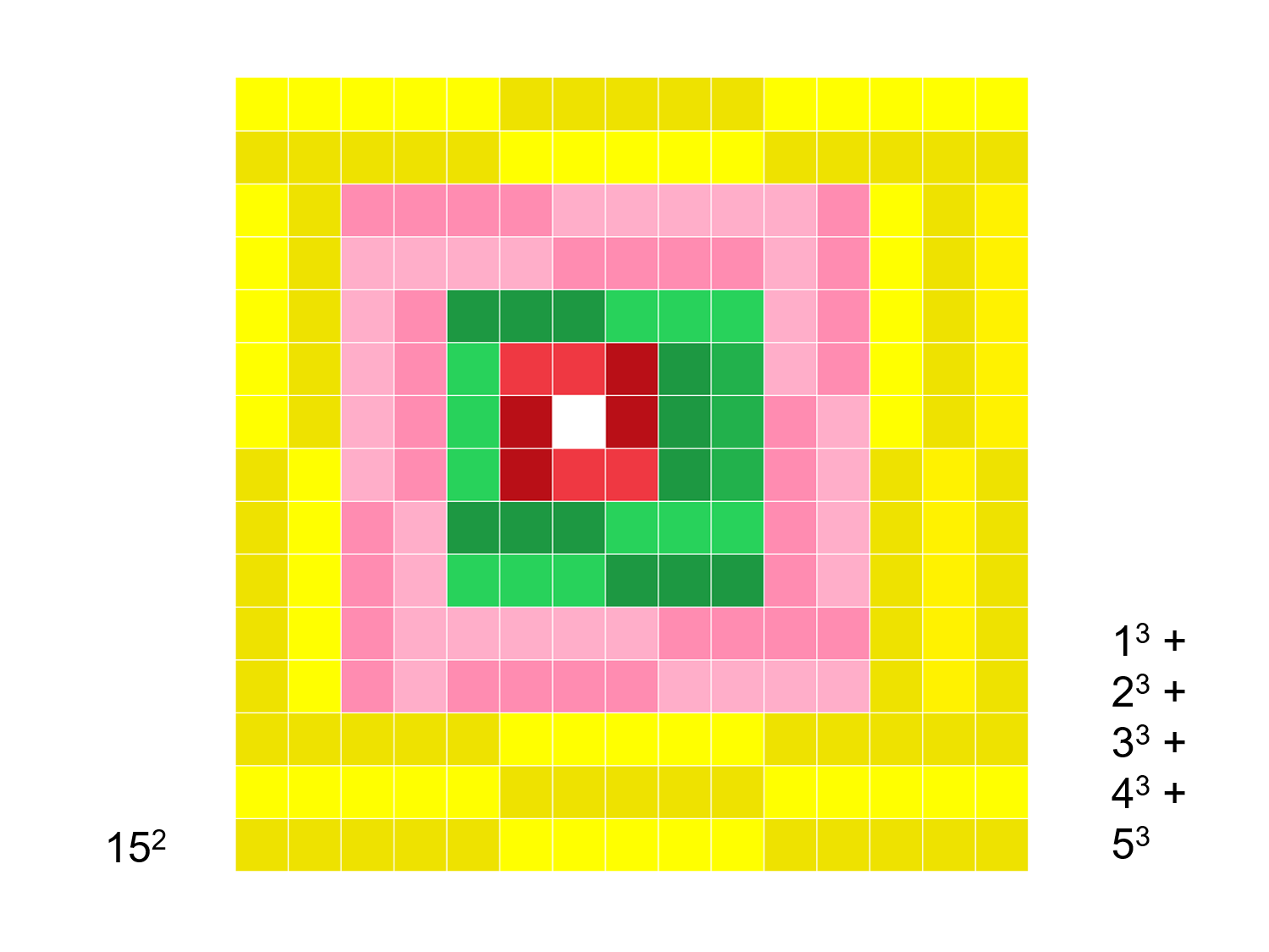
summing the cubes
Nicomachus appreciated this rule (~60 to 120 CE)
thanks to David Wells for the numerical approach
a ppt is here
this task can begin with an exploration of numbers
with a result being easy to find
it can be justifed using numbers
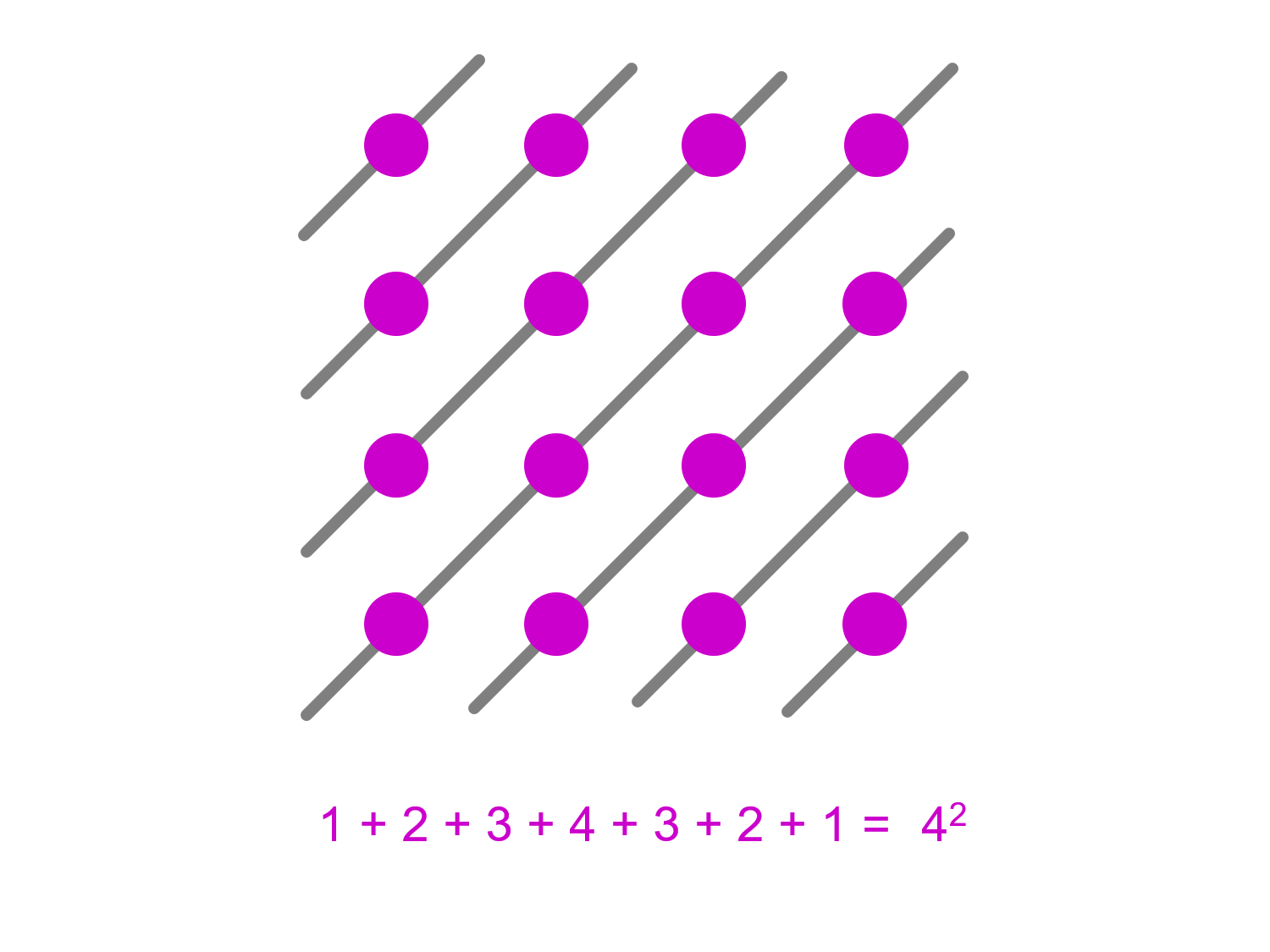
there is a novel diagrammatic representation
algebra can be tackled (if you can expand a cubic bracket) to justify the uniqueness of the first few results
a result that is needed later
see youtube
or nrich 325
how can you be sure that this process continues?
an interesting alternative diagram
possibly using Cuisenaire rods
algebra used to justify that you need to start at 1
(for the first two, three and four consecutive cube cases anyway)
the three consecutive cube case is easiest:
thanks to David Wells for the numerical approach
a ppt is here
this task can begin with an exploration of numbers
with a result being easy to find
it can be justifed using numbers
there is a novel diagrammatic representation
algebra can be tackled (if you can expand a cubic bracket) to justify the uniqueness of the first few results
a result that is needed later
see youtube
or nrich 325
how can you be sure that this process continues?
an interesting alternative diagram
possibly using Cuisenaire rods
algebra used to justify that you need to start at 1
(for the first two, three and four consecutive cube cases anyway)
the three consecutive cube case is easiest:
Friday, 29 November 2019
some square number patterns
all due to David Wells
proofs could involve expanding brackets and simplifying expressions
or use the difference of two squares equivalence
or could be considered by using diagrams
proofs could involve expanding brackets and simplifying expressions
or use the difference of two squares equivalence
or could be considered by using diagrams
Friday, 1 November 2019
power proofs
a ppt is here
working out rules for powers
using Pascal's triangle, establish that because if 'n' is a digit, n^5 ends in the same digit 'n'
then so does (n + 10)^5
and so does (n + 10k)^5
working out rules for powers
using Pascal's triangle, establish that because if 'n' is a digit, n^5 ends in the same digit 'n'
then so does (n + 10)^5
and so does (n + 10k)^5
Sunday, 13 May 2018
red and yellow spheres
picking twice, with replacement
a ppt is here
exploring whether or not you are more or less likely to obtain two spheres of the same colour (RR or YY) than two speres of different colours (RY or YR)
or use a tree diagram
options with a total of 9 spheres still
various totals
you can just consider half of the diagram
is the fawn area larger or smaller than the red plus the yellow?
fold once
fold twice
approached algebraically
an alternative algebraic justification
utilising pythagoras to justify the result
a ppt is here
exploring whether or not you are more or less likely to obtain two spheres of the same colour (RR or YY) than two speres of different colours (RY or YR)
or use a tree diagram
options with a total of 9 spheres still
various totals
you can just consider half of the diagram
is the fawn area larger or smaller than the red plus the yellow?
fold once
fold twice
approached algebraically
an alternative algebraic justification
utilising pythagoras to justify the result
Monday, 18 December 2017
equable triangles
the proof that there are only five equable triangles (integer sided) was done in 1904
this version of a proof is largely due to David Wells with small bits of help from me
it is complex but involves only GCSE tools
this version of a proof is largely due to David Wells with small bits of help from me
it is complex but involves only GCSE tools
Labels:
cosine rule,
equable shapes,
proof,
pythagorean triples,
similarity,
sine and area
Subscribe to:
Posts (Atom)