a ppt is here
median
don steward
mathematics teaching 10 ~ 16
don steward
mathematics teaching 10 ~ 16
Showing posts with label nth term. Show all posts
Saturday, 2 November 2019
Wednesday, 23 May 2018
Thursday, 16 November 2017
arithmetic sequences meets equations
this task was devised by Martin Wilson, of Harrogate
the powerpoint is here
students could substitute numbers (trial and improvement)
or, if they appreciate that there are equal 'steps' between adjacent (and other) pairs of terms,
they can set up and solve linear equations with the unknown on both sides
for the quadratic version there may appear to be two solutions
but checking will show that, actually, only one of these works
the powerpoint is here
students could substitute numbers (trial and improvement)
or, if they appreciate that there are equal 'steps' between adjacent (and other) pairs of terms,
they can set up and solve linear equations with the unknown on both sides
for the quadratic version there may appear to be two solutions
but checking will show that, actually, only one of these works
Thursday, 25 May 2017
fraction sequences
starts by counting on
fraction sequences with their 'simplest' (cancelled) form on the powerpoint
this could be done orally, with some explanations sought
then finding three missing terms and a general rule (nth term) for a fraction sequence
with (assumed) regular increases on the first resource
and a regular pattern (nth term) for the numerators and the denominators on the second resource
students might need nudging to consider equivalent fractions - hopefully not...
fraction sequences with their 'simplest' (cancelled) form on the powerpoint
this could be done orally, with some explanations sought
then finding three missing terms and a general rule (nth term) for a fraction sequence
with (assumed) regular increases on the first resource
and a regular pattern (nth term) for the numerators and the denominators on the second resource
students might need nudging to consider equivalent fractions - hopefully not...
Friday, 10 March 2017
in the limit
puntmat posted an interesting idea (7th August 2014) involving various functions and exploring their limit as n gets very large indeed (tends to infinity)
these resources involve two of their functions plus another one
what fractions are shaded with a colour (out of the whole rectangle) at each stage?
what happens to this fraction as the shape (n) grows bigger and bigger?
all give rise to a common set (or subset) of fractions
with the same limit...
why?
the puntmat post helpfully included some animated gifs for two of these sequences:
these resources involve two of their functions plus another one
what fractions are shaded with a colour (out of the whole rectangle) at each stage?
what happens to this fraction as the shape (n) grows bigger and bigger?
all give rise to a common set (or subset) of fractions
with the same limit...
why?
the puntmat post helpfully included some animated gifs for two of these sequences:
Sunday, 22 January 2017
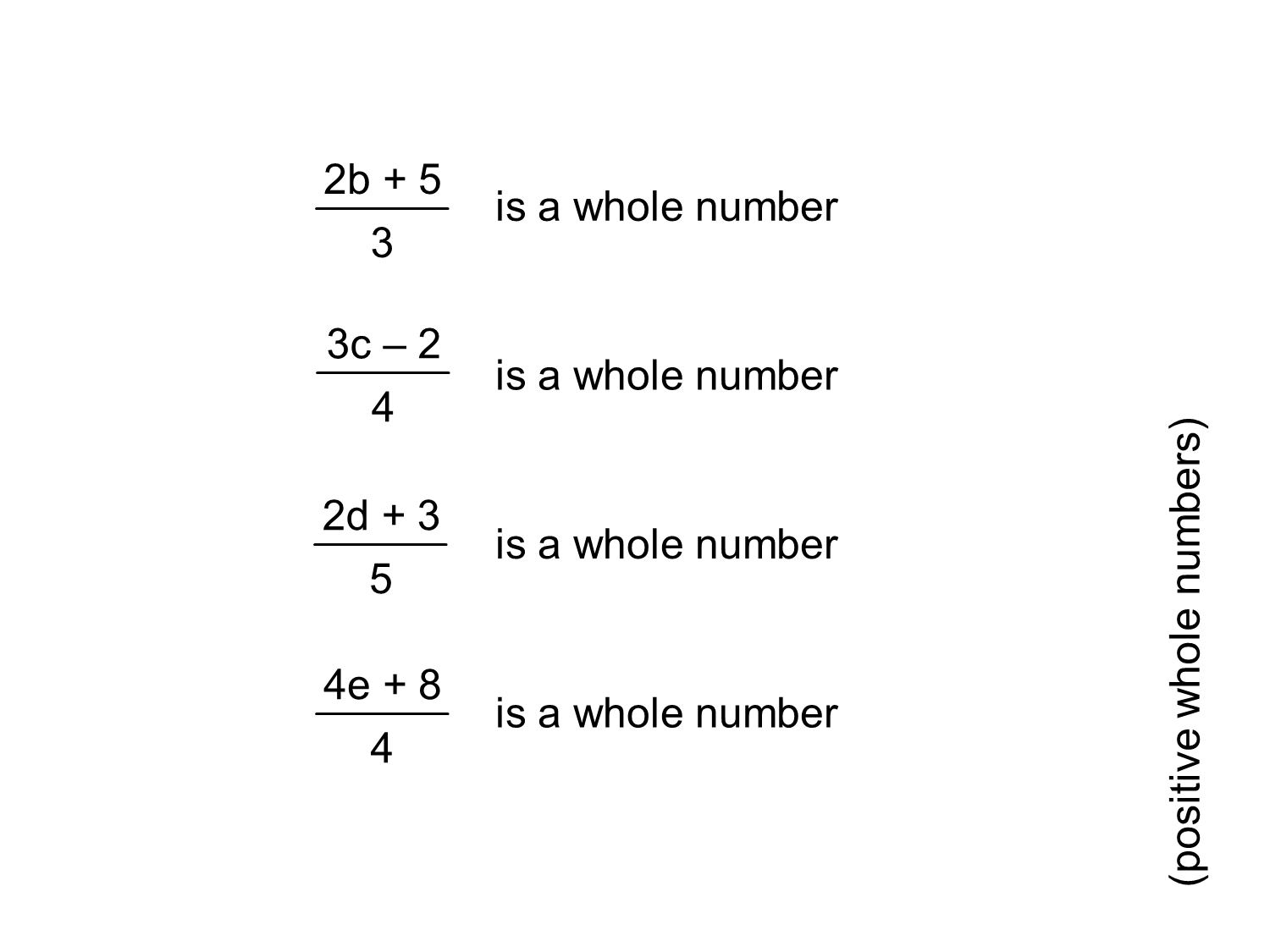
getting a positive whole number
largely a substitution exercise
involving trial and perseverance, with some thought maybe
script:
"I'm thinking of a number and you don't know what it is (or do you...?)
here it is [write b]
whatever it is, I'll multiply it by 2 [put a 2 in front of the b]
then I'll add 5 to that
then I'll divide all this by 3 [maybe emphasise by drawing the line slowly, making sure that students are looking at the board]
what does this expression say happened to my number?
OK, all of this here [putting a hand over the expression] is 9
so what was my number?
good, now I'm interested in what other positive whole numbers that this expression could be..."
find a general form for the letters
possibly explaining why these work
involving trial and perseverance, with some thought maybe
script:
"I'm thinking of a number and you don't know what it is (or do you...?)
here it is [write b]
whatever it is, I'll multiply it by 2 [put a 2 in front of the b]
then I'll add 5 to that
then I'll divide all this by 3 [maybe emphasise by drawing the line slowly, making sure that students are looking at the board]
what does this expression say happened to my number?
OK, all of this here [putting a hand over the expression] is 9
so what was my number?
good, now I'm interested in what other positive whole numbers that this expression could be..."
find a general form for the letters
possibly explaining why these work
Wednesday, 29 June 2016
find the linear rule
given 7 points that fit a (linear) rule
but 2 of them are incorrect
from an idea by David Wells
plotting them as points seems to be cheating...
however, putting them in order is eminently sensible
the powerpoint goes through a couple of examples
but 2 of them are incorrect
from an idea by David Wells
plotting them as points seems to be cheating...
however, putting them in order is eminently sensible
the powerpoint goes through a couple of examples
Friday, 6 May 2016
bike stand algebra
students can find general rules and possibly find the value for the next bike stand in the sequence
fairly realistic data - only tweaked slightly...
all are the same width and height
fairly realistic data - only tweaked slightly...
all are the same width and height
Wednesday, 30 December 2015
Monday, 16 November 2015
amount of blood
the following tables are from the Welsh government numeracy sample materials (2013)
assume a linear sequence (constant difference)
Wednesday, 8 July 2015
Subscribe to:
Posts (Atom)