median
don steward
mathematics teaching 10 ~ 16

Showing posts with label fractions. Show all posts

Monday, 21 November 2016

area mazes

these puzzles are very similar to those produced by Naoki Inaba, a prolific puzzle composer
they were featured in the Guardian by Alex Bellos on 3rd August 2015 and in the NY Times on 17th August 2015

the puzzles can all be done using integers

once the puzzles have been done it can be interesting to use fractions to justify lengths or areas


Wednesday, 29 June 2016

that's curious

the powerpoint involves
  • decimals
  • directed numbers
  • fractions
sometimes the relationship does hold even though it usually doesn't


Tuesday, 28 June 2016

sum product

a curious relationship that works for a restricted set of numbers

intended to practice many number skills

thanks to David Wells

powerpoint

work out the rule
find as many solutions as you can
find the missing number
what relationships can be found connecting the three outside numbers to th middle one?

Saturday, 6 February 2016

mid-point on a line

a ppt is here

the mid-point on a line is 3
what numbers could be either side of it?

varying the gap:

  • simple numbers
  • fractions
  • negative numbers
  • decimals
  • big numbers
  • in general...


Friday, 8 May 2015

self-inverse and periodic functions

some functions, if repeatedly used (i.e. iterated) return to a start value and it can be interesting to explore these - by operating with fractions preferably, or using a calculator

it can be demanding to firmly establish how many steps it takes to return to a start value (the period) algebraically

the 'usual' self-inverse functions are of a form similar to:
f(x) = 10 - x and
f(x) = 12/x

what happens if you work out 10 - 3 and then subtract the result from 10?
leading to an appreciation that 10 - (10 - n) is n

however, there are many more examples of self-inverse rational functions
here are a few:


etc.
etc.
there is a simple enough rule for such functions to be self-inverse

but it's not that easy to justify...


for practice in dividing fractions and working with directed numbers, self-inverse functions provide an interesting context:
  • put a number ('seed' value) into one of the functions (above) 
  • feed the output (y-value) back into the function


what happens?
try this with several input (start) numbers...


why is the process problematic if the denominator is = 0?
other than for a problematic x value, does the number always seem to return to the start?
what if x is a fraction, or a negative number, or a negative fraction?

what happens with these functions?


Tuesday, 3 February 2015

both ways extensions

these resource sheets seek to involve decimals and fractions in the task 'both ways'


Tuesday, 26 July 2011

thirds and fifths

[based on an idea from the AQA GCSE problem solving questions 2008]

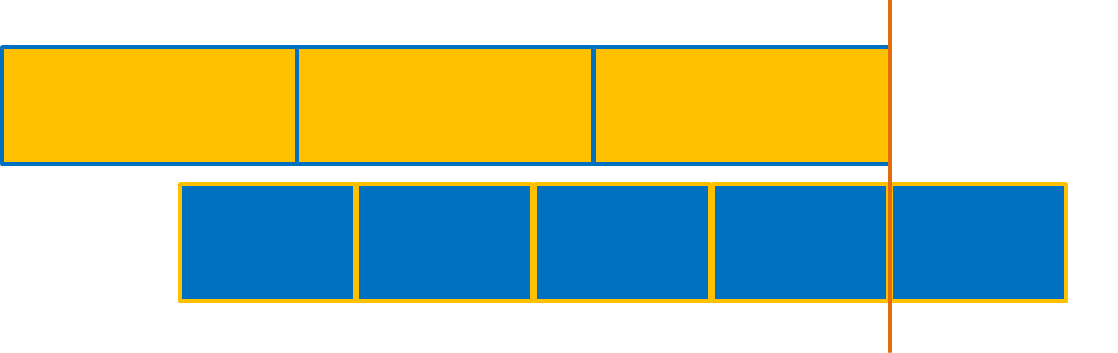
two strips of card are 30cm long
one is divided into thirds
the other is divided into fifths


what are the total overall lengths for these three arrangements?


what other lengths can be made?
why must the overall lengths all be even?

establish that all but four even lengths between 30cm and 60 cm (inclusive) can be made in this way (by lining up two of the fraction marks)

Saturday, 26 March 2011

hexagon fractions

what fraction of the
hexagon is
the orange shape?


this work has been developed and discussed in detail by Derek Ball and Barbara Ball (MT March 2008)

the bottom right-hand picture is a useful starting place
folding bits inwards needs some additional justification - but is a helpful insight/start

the top left picture can also use this way of viewing (folding technique) to help establish the fraction

the other two pictures can be seen as repeated applications of this technique

Thursday, 30 April 2009

Ben's game (not the video game about fighting cancer)


this problem is on the NRich site where there are detailed teaching notes

unfortunately their version only has one solution, so once students have found this solution they need something else to do...

the version here is slightly older (due to Diophantus ~ 200 CE) and has three solutions

Albert, Bella and Camus have a little problem
they don't know how much money they have each but do know it totals less than £50

Albert is going to give a third of their money to Bella
Bella is going to give a quarter of their money to Camus
Camus is going to give a fifth of their money to Albert

they are all going to pass on these fractions before they receive money from another person
they pass on their money all at the same time - all the transactions are simultaneous
so the fractions they pass on are of their original amounts

what they want to happen is that after they have passed on their money,
each will have the same amount of money

what amounts would they need to have to start with for this to happen?
what is the simplest solution?

Sunday, 9 December 2007