my (current) views on ratio units for Y7 (11/12 yr olds), Y8 (12/13 yr olds) and Y9 (13/14 yr olds)
and some suggested diagrams that seem helpful when teaching ratio topics
a powerpoint is here

Showing posts with label ratio. Show all posts
Showing posts with label ratio. Show all posts
Wednesday, 31 July 2019


Saturday, 27 July 2019
yogurt ratios and percentages
using fairly realistic data (in 2019 anyway)
a powerpoint is here


this is a weighted mean calculation
and it is reasonably straightforward to see how/why it works by working through a 'normal' calculation technique
I don't think students should learn it but it is used widely and it is of interest because (a) it's neat (b) it works and (c) it can be related to a 'normal' calculation
density with grids
John Mason commented that the topic of compound measures might be better started with 'density' than speed - because it can be more visual
a powerpoint is here
part : whole ratios, maybe conveniently expressed as a fraction
some involving cancelling
some involving the lcm (or both)
see also population density of grids
and ratio in car parks


a powerpoint is here
part : whole ratios, maybe conveniently expressed as a fraction
some involving cancelling
some involving the lcm (or both)
see also population density of grids
and ratio in car parks


Saturday, 13 July 2019
integer intersection points
the problem is adapted from that posed by user 526427 on MathStack Exchange, March 2nd 2018
using straight line graphs, find two intersection points for various ratios DN : NC (in the form 1 : k where k is an integer)
what if these intersection points have integer x-values?
a powerpoint


 the width doesn't change the x values of the intersection points
(a stretch)


using straight line graphs, find two intersection points for various ratios DN : NC (in the form 1 : k where k is an integer)
what if these intersection points have integer x-values?
a powerpoint


(a stretch)


Thursday, 7 February 2019


Sunday, 3 February 2019
sum, difference, product ratios
from a question posed by Tony Gardiner
trial and improvement is an expected strategy, initially at least, involving equivalent ratios (i.e. scaling)


 one method to do these questions
trial and improvement is an expected strategy, initially at least, involving equivalent ratios (i.e. scaling)


ratio of difference to sum
these resources are based on an idea from the NCETM mastery materials
you are told the ratio of the difference (a - b) to the sum (a + b)
a powerpoint is here


you are told the ratio of the difference (a - b) to the sum (a + b)
a powerpoint is here


Saturday, 2 February 2019
ratio possibly with algebra questions
some demanding ratio questions that are used or adapted from recent GCSE papers and some from the additional/further maths papers
opinions differ on how to teach approaches to these sorts of questions
all can involve algebra (a relatively unthinking and so, for me, safer way) but can also be done by considering e.g. lowest common multiples with the part (or whole) that does not change and then appropriate scaling (equivalent ratios)
the powerpoint is here

 you can solve these questions by listing equivalent ratios (scaling)
and seeing which 'works'
these considerations can be sped up by considering the lcm of what does not change, in this case the number of blue beads (thanks to Richard Trimble)

a bar model might help (even if only retrospectively...)

and then consider what fraction the extra 5 must be of the original red bar
or students might prefer to use an algebraic technique
involving simultaneous equations:

or, setting up an equation and cross-multiplying:


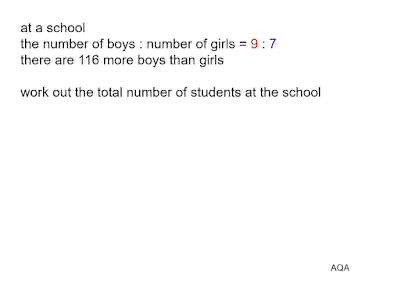


 the course AQA 8360 has involved questions like ratio (iii)


show that the second statement follows from the first
opinions differ on how to teach approaches to these sorts of questions
all can involve algebra (a relatively unthinking and so, for me, safer way) but can also be done by considering e.g. lowest common multiples with the part (or whole) that does not change and then appropriate scaling (equivalent ratios)
the powerpoint is here


and seeing which 'works'
these considerations can be sped up by considering the lcm of what does not change, in this case the number of blue beads (thanks to Richard Trimble)

a bar model might help (even if only retrospectively...)

and then consider what fraction the extra 5 must be of the original red bar
or students might prefer to use an algebraic technique
involving simultaneous equations:

or, setting up an equation and cross-multiplying:


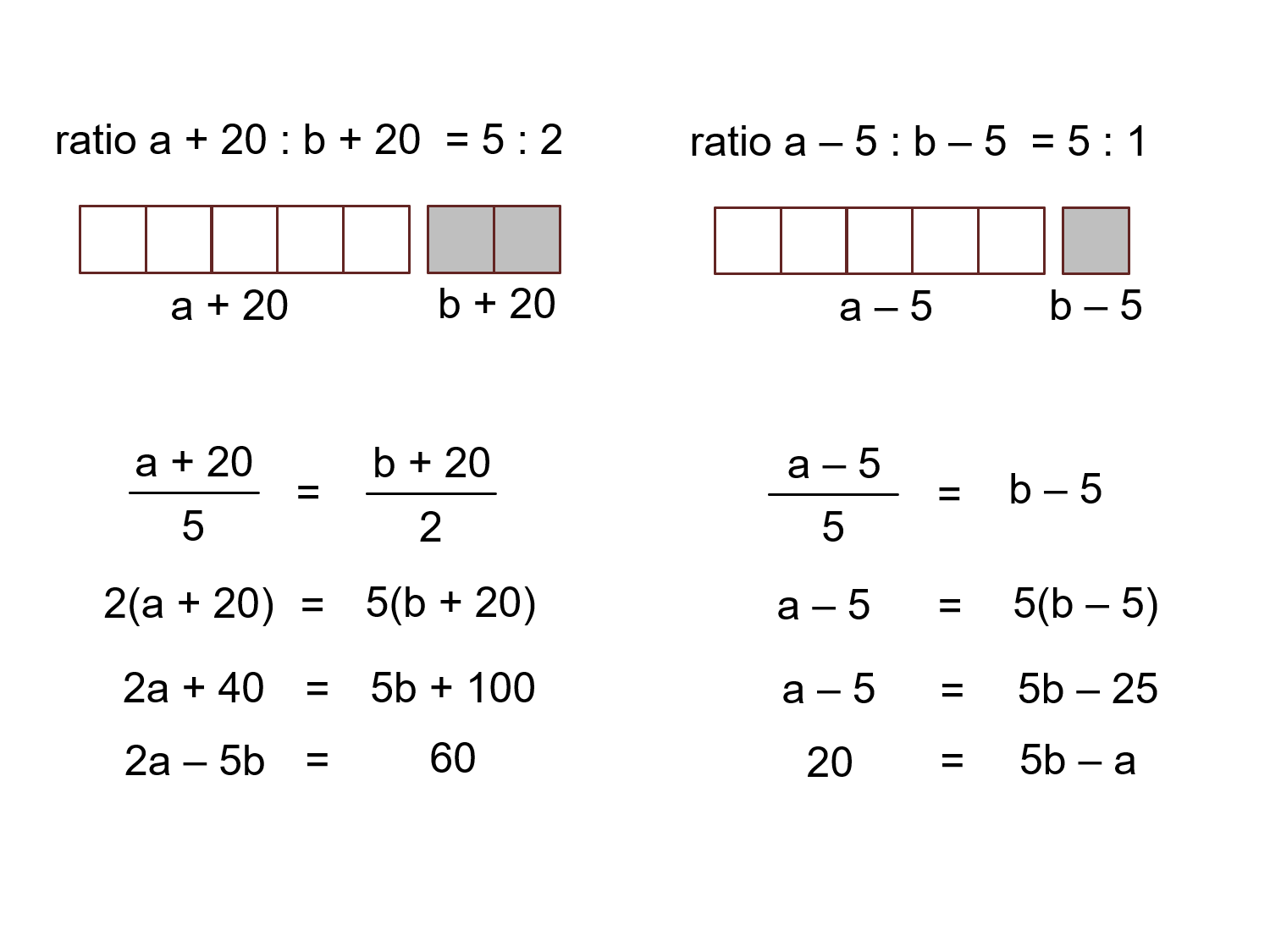


show that the second statement follows from the first
Subscribe to:
Posts (Atom)