median
don steward
mathematics teaching 10 ~ 16

Tuesday, 22 November 2016

squares inside rectangles (1) numbers

(reworked)
number work practice - addition and subtraction, hopefully without a calculator
the powerpoint is here

some tasks involve simple simultaneous equations (e.g. two numbers sum to 10 with a difference of 2, what are they?)

the numbers are the lengths of the squares rather than their area
sometimes you have to find the right lengths to compare e.g. in the 7, 5, 7 resource (two) below,
having found 12 (above the 7 + 5) then 12 + 5 = ? + 7

 find the missing numbers
a 'perfectly squared' rectangle has all the squares of different sizes

an 'imperfectly squared' rectangle
what are the missing lengths?


squares inside rectangles (2) equations

forming and solving linear equations with the unknown on both sides


it can be tricky to see which lengths to compare to find expressions for the squares

the powerpoint goes through a couple of examples (that are probably necessary for students to progress)

the numbers are the (integer) lengths of the square

all of these are 'perfect rectangles' in that none of the square sizes are repeated

this work is developed from the numbers attained by Stuart Anderson on www.squaring.net where there is a vast amount of information about squares inside rectangles and related notions


Monday, 21 November 2016

loci and regions

harking back to a Euclidean tradition

the tasks at sciencevsmagic are interesting and challenging
if you have IT availability in the classroom

a good powerpoint is Dan Walker's
I've slightly adjusted it but this is his (admirable) work

a powerpoint showing the constructions (click and leave but click between slides)

a loop to remind students of the loci they need to know (which could be played whilst they work: click and leave)

some questions


alternative construction for the angle bisector


these are past paper questions from the (then) KS3 SAT papers in England


area mazes

these puzzles are very similar to those produced by Naoki Inaba, a prolific puzzle composer
they were featured in the Guardian by Alex Bellos on 3rd August 2015 and in the NY Times on 17th August 2015

the puzzles can all be done using integers

once the puzzles have been done it can be interesting to use fractions to justify lengths or areas


Sunday, 20 November 2016

cylinder from an A4 sheet

the first task (an open cylinder) is well known

the closed cylinder was suggested to me by Martin Wilson in Harrogate (thanks)
NRich have produced a version (nrich2664)
it is a calculator task


Friday, 18 November 2016

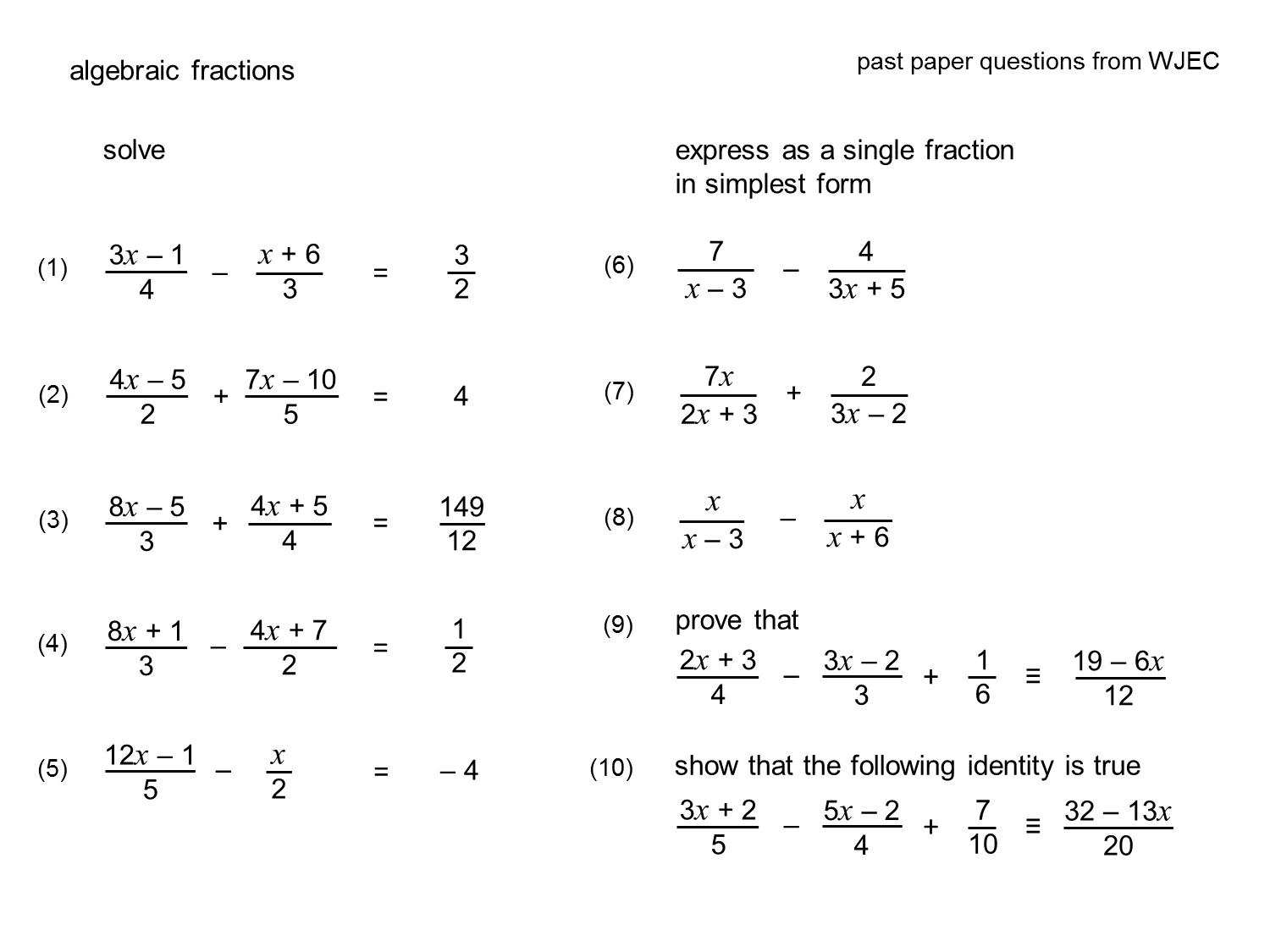
algebraic fractions

start with numbers
see what happens
look for patterns/commonality
consider a method for (adding and) subtracting fractions - picture this as 'wigwam'

decide upon a general rule/form for the family type
explain, using algebraic fractions, why the numerator is always one particular number

the powerpoint


'wigwam' as a visual prompt for the steps

Thursday, 17 November 2016

3D pythagoras

the powerpoint has an example using an actual box that was shown to students


an American, wind-turbine holding kit supplied without the wire